
Create a Dynamic Library Link (.dll) in VB.Net
In this tutorial of Create a DynamicLibrary Link (.dll) in VB.Net, you will learn how to create a dynamic library link using vb.net in Microsoft Visual Studio 2013. Let me explain to you first the advantages of dynamic library links.
Advantages:
- You can make your own modified sets of parameters and methods for you to do less coding and typing especially when you are used to do long codes.
- It will make you feel like an advanced VB.Net programmer when creating a dynamic library link using vb.net.
Here are the following steps to create your dynamic library link using vb.net:
- Open your Microsoft Visual Studio 2013 and click New Project, after clicking New Project, select from the Visual Basic from the Templates corner left tab then select Class Library. (see the image below).

2. After creating your new project, you can name the class as you like. Let’s make a sample code for our class library project.
Public Class Class1

Public Shared Function addValues(number1 As Integer, number2 As Integer)
Dim sum As Integer
sum = number1 + number2
Return sum
End Function

End Class
As you can see, we have a public function named addValues. This function will automatically sum the two integers depending on the user’s input.
3. Build your project and go to your Project Folder > Project Folder > bin > Debug. You can see that there’s a .dll file which came from our recently coded class library project (see the image below).

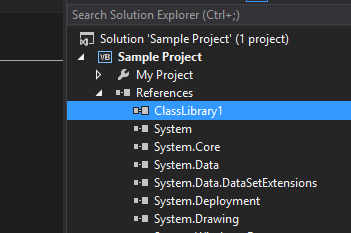
4. Now, let’s use our .dll file! Create a new Visual Basic project and go to reference located at the Solution Explorer of your project.
Then add reference and locate your created .dll file. After successfully adding your .dll file, you can see that at your references tab. (see the image below).
5. Now, import your .dll file on to your project by writing this at the top of your code sheet, Imports ClassLibrary1.Class1 (ClassLibrary1 is the name of our .dll project and Class1 is our class inside the .dll project.) After importing, you can now call your public sub inside that .dll file! We exampled the function in the textbox.
Imports ClassLibrary1.Class1

Public Class Form1

Private Sub Form1_Load(sender As Object, e As EventArgs) Handles Me.Load
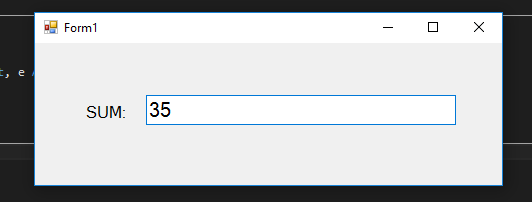
TextBox1.Text = addValues(15, 20)
End Sub

End Class
While the form is loading, automatically the project will call the function and produce an output on our textbox! (Check the image below).
Success! You have created your own .dll file and it is easy to add two integers at the same time you can create your own line of codes depending on your convenience!
RAR Extraction Password:
Password: luffypirates
For questions or any other concerns, you can contact me through the following:
E-Mail: ianlavapiez@gmail.com
Facebook: facebook.com/kirk.lavapiez
Contact No.: +639771069640
To download the sample project with the line of codes, click here.
Ian Hero L. Lavapiez
BSIT Graduate
System Analyst and Developer
Related topic(s) that you may like:
Technology stack and requirements
To run this VB.NET project, you need the following on your development machine:
- Visual Studio 2019 or later. The free Community Edition is enough for building, debugging, and running the project.
- .NET Framework 4.7.2 or higher. Most Windows 10 and 11 systems have it preinstalled through Windows Update.
- MySQL Server 8.0 or MSSQL Express 2019. Choose whichever your capstone panel prefers; both work with VB.NET data adapters.
- MySQL Connector/NET or SqlClient library. Add via NuGet Package Manager inside Visual Studio.
- Crystal Reports (optional). Required only if the project generates printable reports; install the runtime redistributable.
Installing the source code
The download link contains a ZIP archive with the full solution. Extract and set up in five steps:
- Extract the archive to a folder outside Program Files (avoids permission issues).
- Open the .sln file in Visual Studio. It loads the full solution with all forms and modules.
- Restore NuGet packages. Right-click the solution then Restore NuGet Packages if prompted.
- Import the database. Locate the .sql file in the archive and import via phpMyAdmin (MySQL) or SQL Server Management Studio.
- Update the connection string in App.config or module code to match your local database name, user, and password.
How to use this project for your BSIT capstone
This VB.NET project maps cleanly to standard BSIT capstone documentation. Suggested chapter alignment:
- Chapter 1 (Introduction). Discuss the problem the system solves in real-world context. Cite Philippine business or academic use cases where a manual process could be replaced.
- Chapter 2 (Review of Related Literature). Compare this system’s features against 5-10 similar published projects. Cite journals like IJERT or IEEE Access for academic-standard sources.
- Chapter 3 (Methodology). Include Use Case Diagram, Data Flow Diagram, Entity Relationship Diagram, and Activity Diagram covering all major workflows in the system.
- Chapter 4 (Results and Discussion). Screenshot each module of the running system with a caption explaining what data it processes and which user role interacts with it.
- Chapter 5 (Conclusion and Recommendations). Identify features that could be added in a Version 2, such as web dashboard, mobile app, or REST API export.
Modules typical of Create a Dynamic Library Link (.dll)
- Student information. Personal info, guardian details, enrollment status, and program of study.
- Enrollment / registration. Term-by-term subject selection with prerequisite checking.
- Grading system. Teacher input for quiz, exam, and project scores with weighted average computation.
- Report card generation. Printable grade slip and transcript of records.
- Library / borrowing (optional). Track book borrowing, return date, and fine computation.
- Announcements and news. Post school-wide bulletins visible from the login screen.
Common enhancements for capstone review
- Online portal. Add ASP.NET web portal so parents and students see grades from home.
- SMS grade notification. Auto-send new-grade alerts to the parent’s registered mobile number.
- Digital ID card generation. Print student ID with photo, QR code, and academic year.
- Alumni tracking. Extend the database to include post-graduation contact info and current employer.
Official documentation
Frequently Asked Questions
How does this VB.NET library management system work?
Book catalog (ISBN, categories, copies), member registration, borrow/return workflow with due dates, fine calculation, reservations, reports.
What Visual Studio and SQL Server versions does this VB.NET project require?
Most projects use VB.NET WinForms on .NET Framework 4.5+ with SQL Server 2012 Express or higher. To run: install Visual Studio 2019 / 2022 (Community is free) with the ‘Desktop development with .NET’ workload, install SQL Server Express + SSMS, open the .sln file, build, run.
How do I set up the database for this VB.NET project?
Open SQL Server Management Studio (SSMS) and connect to your SQL Server (e.g. localhost\SQLEXPRESS). Right-click Databases, choose Restore Database OR New Database then import the included .sql script. Update the connection string in App.config (or in code-behind Module) with your server name + credentials. Rebuild and run.
Can I use this VB.NET project for a BSIT capstone or thesis?
Yes, VB.NET is one of the most accepted languages by Philippine BSIT panels. Extend it: add role-based access (admin/staff/customer login redirect), Crystal Reports or RDLC reports, dashboards with Chart control, audit log, multi-branch support. Pair with Chapter 1-5 documentation matching your panel’s rubric.
Why am I getting ‘connection error’ or ‘cannot find SQL Server’?
Three common VB.NET issues: (1) Connection error: SQL Server isn’t running. Open SQL Server Configuration Manager and verify SQL Server (SQLEXPRESS) service is started. (2) Wrong server name in connection string. Try .\SQLEXPRESS, (local)\SQLEXPRESS, or your machine name. (3) Login failed: SQL Server is set to ‘Windows-only’ authentication. Switch to Mixed Mode in SSMS Server Properties, Security.
Where can I find more VB.NET projects with source code?
Browse the VB.NET Projects hub for the full library. For C# WinForms alternatives see C# Projects. For ASP.NET web alternatives see ASP.NET Projects. For BSIT capstone idea lists see 150 Best Capstone Project Ideas.