
Stock Management System In PHP is the process of keeping track of the goods your business plans to sell. This means getting, storing, arranging, and keeping track of the goods.
Managing your stock also means keeping track of how your stock changes over time.
About the Project
The Stock Management was developed using PHP, HTML, CSS, JavaScript, Bootstrap and MySQL Database as Back-End.
This Stock Management System In PHP is used to track the products in and out from the inventory, the user can add products, update, delete and track, and keep the records of products in a proper way.
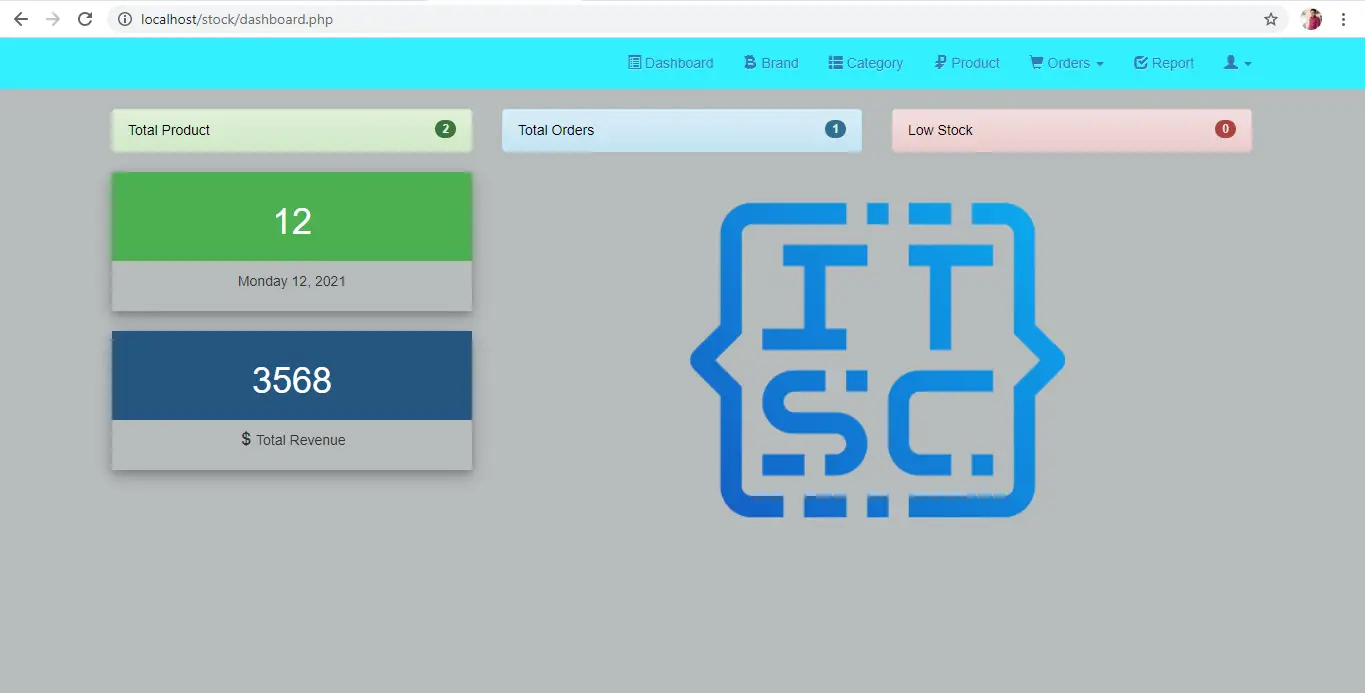
A Stock Management System In PHP With Free Source Code has five features or modules first the Brand which contains the brand name of the product and status if the product is available or not, second is Category which contains what category name of the product and also status, third is Product which contains name of product, rate, quantity, brand, category and status of the product, fourth is Orders which contains date of order, client/customer, contact, total of ordered item and payment status and last is the Report which contains all the transaction from the customer.
In this Stock Inventory Management System also includes a Stock Management System Source Code Free Download, just find the downloadable source code below and click to start downloading.
Project Information’s
| Project Name: | Stock Management System In PHP With Source Code |
| Language/s Used: | PHP |
| PHP version (Recommended): | 5.6.3, 7.4.12 |
| Database: | MySQL |
| Type: | Website, Web Application |
| Developer: | IT SOURCECODE |
| Updates: | 0 |
Stock Management System Project Report in PHP Features
- Brand
- Category
- Product
- Orders
- Report
To start executing this Stock Management System With PHP MySQLi Bootstrap Open Source Project, makes sure that you have sublime or any platform of PHP and MySQL installed in your computer.
How to run the Stock Management System in PHP with Source Code
Time needed: 5 minutes
These are the steps on how to run Stock Management System In PHP With Source Code.
- Step 1: Download source code.
First, download the source code given below.

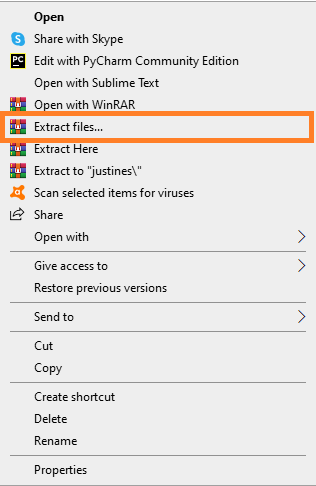
- Step 2: Extract file.
Second, after you finished download the source code, extract the zip file.

- Step 3: Copy project folder.
Third, copy the project folder and paste it into the xampp/htdocs folder.

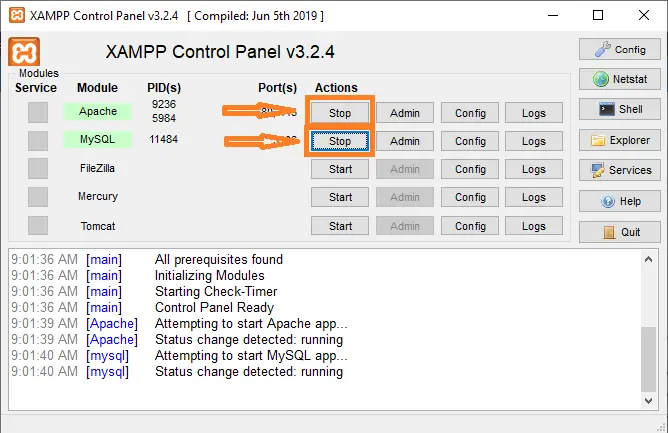
- Step 4: Open xampp.
Fourth, open xampp and start the apache and MySQL.

- Step 5: Open browser.
Fifth, Open a browser and go to URL “http://localhost/phpmyadmin/”

- Step 6: Create database.
Sixth, click on databases tab and Create database naming “stock”.

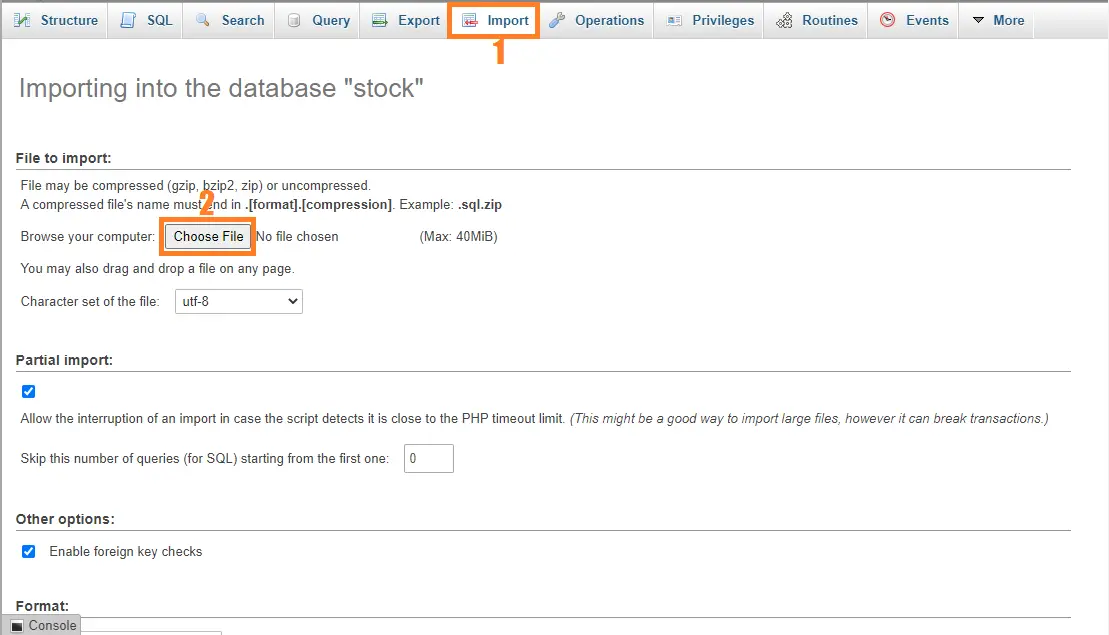
- Step 7: Import “stock.sql”.
Seventh, Click on browse file and select “stock.sql” file which is inside “database” folder and after import click “go“.

- Step 8: Open browser and type folder name.
Eight, Open a browser and go to URL “http://localhost/stock/”.

- Step 9: Explore manipulating.
Final step , Login from the User’s login side. Just provide the Admin’s login detail, it will redirect you to Admin panel.




Download Source Code below
Anyway, if you want to level up your programming knowledge, especially PHP, try this new article I’ve made for you Best PHP Projects With Source Code Free Download.
- Admin Username: admin
- Admin Password: password
Summary
The Stock Management System is develop web application use JavaScript, CSS. using PHP MySQL, this software is used to track the products in and out from the inventory, the user can add products, update, delete and track, and keep the records of products in a proper way.
Technology stack and requirements
To run this PHP project, you need these tools on your development machine:
- XAMPP or WAMP server. Bundles Apache, MySQL, and PHP so you can run PHP on Windows without individual installs. Free from apachefriends.org.
- PHP 8.0 or higher. Included with XAMPP. Older versions (5.x, 7.x) may work but modern PHP features improve security and performance.
- MySQL or MariaDB. Comes with XAMPP. phpMyAdmin manages the database through a browser UI.
- VS Code or PhpStorm. Free code editor with PHP syntax highlighting, IntelliSense, and debugging support.
- Web browser. Chrome, Firefox, or Edge for testing the running app.
Installing the source code
- Download the archive. Get the ZIP file from the download link on this page and extract it.
- Move to htdocs. Place the extracted folder inside C:\xampp\htdocs\ so Apache can serve it.
- Import the database. Open http://localhost/phpmyadmin, click Import, and select the .sql file included in the archive.
- Update database credentials. Open the config.php or connection.php file and set the correct database name, username, and password (default XAMPP: root / empty password).
- Run the project. Start Apache + MySQL in XAMPP, then visit http://localhost/your-project-folder/ in a browser.
Using this project for your BSIT capstone
This PHP project maps cleanly to standard BSIT capstone documentation. Suggested chapter alignment:
- Chapter 1 (Introduction). Discuss the problem the system solves in real-world context. Cite Philippine business or academic use cases where a manual process could be replaced.
- Chapter 2 (Review of Related Literature). Compare this system’s features against 5-10 similar published projects. Cite journals like IJERT or IEEE Access for academic-standard sources.
- Chapter 3 (Methodology). Include Use Case Diagram, Data Flow Diagram, Entity Relationship Diagram, and Activity Diagram covering all major workflows.
- Chapter 4 (Results and Discussion). Screenshot each module of the running system with a caption explaining what data it processes and which user role interacts with it.
- Chapter 5 (Conclusion and Recommendations). Identify features that could be added in a Version 2, such as mobile app, REST API export, or AI-powered analytics.
Modules typical of Stock Management System
- Product master data. CRUD forms for adding, editing, and archiving products with SKU, price, category.
- Stock receiving. Record incoming batches from suppliers with quantity, cost, and expiry.
- Point of Sale. Cashier interface with barcode input, quantity, subtotal, discount, and change.
- Stock adjustment. Manual correction entries for damage, expiry, or shrinkage with reason codes.
- Reports. Sales-by-day, stock-on-hand, top-selling products, low-stock alerts.
- User management. Role-based login (Admin, Cashier, Manager) with password hashing and audit trail.
Common enhancements for capstone review
- Barcode integration. Add USB barcode-scanner input on POS form for faster checkout.
- Multi-branch support. Add a Branch table so a single database serves multiple store locations.
- Auto reorder alerts. Send email notification when stock falls below a defined threshold.
- Data export to Excel. Use PhpSpreadsheet library to export reports for offline analysis.
Official documentation
Frequently Asked Questions
How does this PHP stock management system work?
Tracks per-item quantity, in/out movements, supports multiple warehouses or branches. Lighter scope than full inventory + sales combo.
What PHP and MySQL versions does this project require?
Most projects in this batch run on PHP 7.4 to PHP 8.2 with MySQL 5.7+ or MariaDB 10+. A few older projects need PHP 5.6 (deprecated, use XAMPP 7.x). To run: install XAMPP / WAMP / Laragon, extract project to htdocs, import the included .sql file via phpMyAdmin, edit the connection file (usually config.php or db_connect.php) with your DB credentials, browse to the project URL in your browser.
How do I set up the database for this PHP project?
Open phpMyAdmin (http://localhost/phpmyadmin/ on XAMPP), create a new empty database with the name specified in the project’s config.php. Click the Import tab, choose the included .sql file, click Go. Then edit config.php (or includes/connection.php) with: ‘localhost’, your MySQL username (usually ‘root’), your MySQL password (usually blank for XAMPP), and the database name.
Can I use this PHP project for a BSIT capstone or thesis?
Yes, but extend it. A bare CRUD app is too narrow for full capstone scope. Add: user roles via session checks, reports/dashboards (Chart.js + AJAX), PDF exports (TCPDF library), email notifications (PHPMailer), real domain extension (analytics, audit log, multi-branch support). Pair with Chapter 1-5 documentation matching your panel’s rubric.
Why am I getting ‘connection error’ or ‘undefined function mysqli_connect’?
Three common PHP issues: (1) Connection error: Apache + MySQL services not running in XAMPP control panel, OR database name in config.php does not match what you created in phpMyAdmin. (2) ‘undefined function mysqli_connect’: MySQL extension not enabled, in php.ini uncomment extension=mysqli (then restart Apache). (3) ‘No such file or directory’: MySQL socket path wrong, use 127.0.0.1 instead of localhost in the connection string.
Where can I find more PHP projects with source code?
Browse the PHP Projects hub for the full library (300+ vanilla PHP systems). For modern PHP MVC alternatives see Laravel Projects (74 systems) or CodeIgniter Projects (32 systems). For BSIT-focused capstone idea lists see 150 Best Capstone Project Ideas.
Related PHP Projects
- Content Management System In PHP With Source Code
- Attendance Management System In PHP With Source Code
- Loan Management System Project In PHP With Source Code
- Fees Management System Project In PHP With Source Code
- Advanced School Management System In PHP With Source Code
- Gym Management System Project In PHP With Source Code
Inquiries
If you have any questions or suggestions about Stock Management System In PHP With Source Code, please feel free to leave a comment below.

Angel Jude Suarez
Full-Stack Developer at PIES IT Solution
Focuses on Python development, machine learning, and AI integration. Has built production AI systems including OpenAI Whisper integration for medical transcription and GPT-4o-powered diagnosis assistance. Strong background in pandas, scikit-learn, and TensorFlow.
Expertise: Python · PHP · Java · VB.NET · ASP.NET · Machine Learning · AI Integration · OpenCV · Django · CodeIgniter
· View all posts by Angel Jude Suarez →
Great Work Done
do you have any idea po why is it when I try to run it display a 404 error.
It says that The requested URL was not found on this server although I followed the steps
You put system folder in inappropriate location.
When products out off stock, the history of order that products also blank (selected product) too.
how do you login to get to home page because its like login is deactivated, I can put details but they are not submitted
homepage for frontend or backend
from frontend, i cannot login to the login form using admin and the password which are recorded to the database
What is the error?
whay i cant log in
What do you you cannot login in admin?
i have provided all login details but it refused to login
You already import the sql database in phpmyadmin?
i cant log in
is there another way to login coz the password and admin provided as login details are not working
You already import the sql database in phpmyadmin?
how do i change VAT from 13 %
You change it inside the code.
Why is it happening like this when I press enter on everything in the navbar?
popup like this.
DataTables warning: table id=manageCategoriesTable – Ajax error. For more information about this error, please see http://datatables.net/tn/7
It means there is an error. OR maybe there is no data in categories table
What is the purpose of using active attribute in both category and brand entities ?