
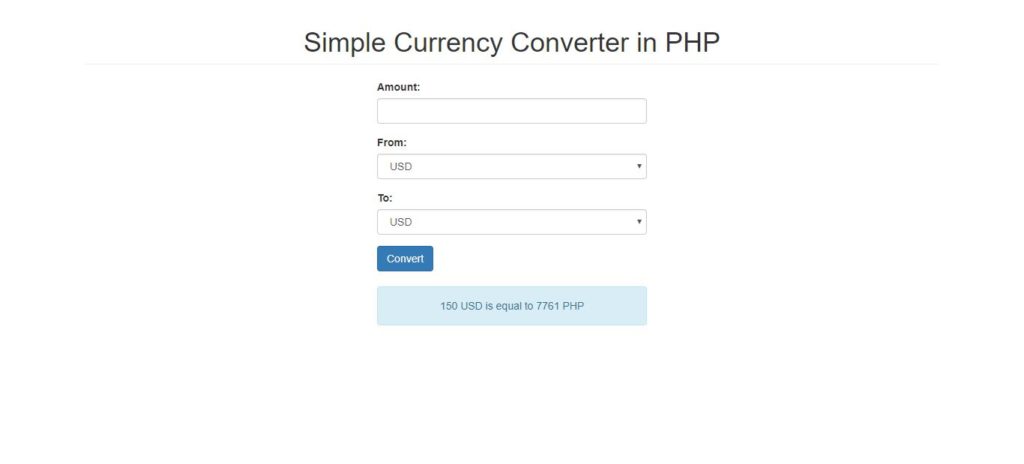
Hello Guys! This tutorial is all about How to Create a Simple Currency Converter in PHP.
Currency Converter is a calculator that converts the value or quantity of one Currency into the relative values or quantities of other currencies.
So let’s get started:
First create a class and name it “converter.php” and add this code:
<?php

class Converter{

	private $rateValue;

	//I have base these rates on USD :)
	private $rates = [
		'USD' => 1.0,
		'GBP' => 0.7,
		'EUR' => 0.800284,
		'YEN' => 109.67,
		'CAN' => 1.23,
		'PHP' => 51.74,
	];

	public function setConvert($amount, $currency_from){
		$this->rateValue = $amount/$this->rates[$currency_from];
	}

	public function getConvert($currency_to){
        return round($this->rates[$currency_to] * $this->rateValue, 2);
	}

	public function getRates(){
		return $this->rates;
	}
}

?>
Next is to create our form that converts our set amount from one currency to another currencies. add this code in index.php:
<?php
session_start();
include_once('Converter.php');
$converter = new Converter();
$rates = $converter->getRates();
?>
<!DOCTYPE html>
<html>
<head>
<title>Simple Currency Converter in PHP</title>
<link href="https://maxcdn.bootstrapcdn.com/bootstrap/3.3.7/css/bootstrap.min.css" rel="stylesheet">
</head>
<body>
Simple Currency Converter in PHP
$currency){
?>
">
$currency){
?>
">
<button type="submit" name="convert" class="btn btn-primary">Convert</button>
</form>
<?php
if(isset($_SESSION['value'])){
?>
<?php
unset($_SESSION['value']);
}
?>
</div>
</div>
</div>
</body>
</html>Lastly, we create our PHP code to convert the amount. and add this code in getconvert.php
<?php

session_start();

require_once('Converter.php');

if(isset($_POST['convert'])){
	$amount = $_POST['amount'];
	$currency_from = $_POST['currency_from'];
	$currency_to = $_POST['currency_to'];

	$converter = new Converter();
	$converter->setConvert($amount, $currency_from);
	$result = $converter->getConvert($currency_to);

	$out = array();
	$out['amount'] = $amount;
	$out['from'] = $currency_from;
	$out['result'] = $result;
	$out['to'] = $currency_to;

	$_SESSION['value'] = $out;
	header('location:index.php');

}
else{
	header('location:index.php');
}

?>
That’s it go and run the program now!
If you have any comments or suggestion about the How to Create a Simple Currency Converter in PHP Message us Directly
Download Source code here:
Technology stack and requirements
To run this PHP project, you need these tools on your development machine:
- XAMPP or WAMP server. Bundles Apache, MySQL, and PHP so you can run PHP on Windows without individual installs. Free from apachefriends.org.
- PHP 8.0 or higher. Included with XAMPP. Older versions (5.x, 7.x) may work but modern PHP features improve security and performance.
- MySQL or MariaDB. Comes with XAMPP. phpMyAdmin manages the database through a browser UI.
- VS Code or PhpStorm. Free code editor with PHP syntax highlighting, IntelliSense, and debugging support.
- Web browser. Chrome, Firefox, or Edge for testing the running app.
Installing the source code
- Download the archive. Get the ZIP file from the download link on this page and extract it.
- Move to htdocs. Place the extracted folder inside C:\xampp\htdocs\ so Apache can serve it.
- Import the database. Open http://localhost/phpmyadmin, click Import, and select the .sql file included in the archive.
- Update database credentials. Open the config.php or connection.php file and set the correct database name, username, and password (default XAMPP: root / empty password).
- Run the project. Start Apache + MySQL in XAMPP, then visit http://localhost/your-project-folder/ in a browser.
Using this project for your BSIT capstone
This PHP project maps cleanly to standard BSIT capstone documentation. Suggested chapter alignment:
- Chapter 1 (Introduction). Discuss the problem the system solves in real-world context. Cite Philippine business or academic use cases where a manual process could be replaced.
- Chapter 2 (Review of Related Literature). Compare this system’s features against 5-10 similar published projects. Cite journals like IJERT or IEEE Access for academic-standard sources.
- Chapter 3 (Methodology). Include Use Case Diagram, Data Flow Diagram, Entity Relationship Diagram, and Activity Diagram covering all major workflows.
- Chapter 4 (Results and Discussion). Screenshot each module of the running system with a caption explaining what data it processes and which user role interacts with it.
- Chapter 5 (Conclusion and Recommendations). Identify features that could be added in a Version 2, such as mobile app, REST API export, or AI-powered analytics.
Modules typical of How to Create a Simple Currency Converter
- Master data. CRUD forms for the primary entities with search and filter.
- Transaction processing. Data entry forms for day-to-day operations the system automates.
- Reports. Formatted printable output summarizing activity per day, user, or category.
- User management. Login with role-based permissions (Admin, Encoder, Viewer).
- Backup and restore. Export database to a .sql file and restore when needed.
Common enhancements for capstone review
- Modernize the UI. Add Bootstrap 5 or Tailwind CSS for a polished appearance.
- Add printable receipts. Use TCPDF or FPDF to generate PDF reports.
- Multi-user concurrency. Ensure database handles simultaneous writes without lost-update errors.
- Rewrite in Laravel. Migrate to Laravel for maintainability and modern development patterns.
Project timeline for BSIT capstone
Typical BSIT capstone teams complete a PHP project of this scope in one full academic semester. Suggested timeline:
- Weeks 1-2. Requirements gathering, interview with target user, initial Chapter 1 documentation.
- Weeks 3-4. Design phase: use case, DFD, ER diagram, mockup screens.
- Weeks 5-8. Core development: database in MySQL, main pages in PHP, CRUD operations.
- Weeks 9-11. Reports, printing, user roles. Test with sample data.
- Weeks 12-13. Documentation: Chapter 3 methodology, Chapter 4 screenshots, Chapter 5 conclusion.
- Week 14. Mock defense with adviser, corrections, final panel.
Panel questions this project typically gets
- What existing systems are similar and how is yours different? Prepare a comparison table showing 3-5 alternatives and the specific gaps your project addresses.
- How do you validate data entry? Walk through validation on 2-3 key forms with regex, range, and required-field enforcement.
- How does the system handle concurrent access? Explain your MySQL transaction strategy and locking approach.
- What is your backup and disaster recovery plan? Document a backup schedule and demonstrate a restore.
- How would you deploy this in production? Explain shared-hosting setup or migration to a Laravel-based cloud deployment.
Deployment options after the defense
- Shared hosting. Upload to cPanel-based shared hosting (Hostinger, GoDaddy) for immediate live access with a custom domain.
- VPS or cloud. Move to DigitalOcean, Vultr, or AWS Lightsail for scalable performance.
- Local LAN install. Host XAMPP on one PC and let 3-5 clients access via the office network.
- Laravel migration. Rewrite with Laravel for cleaner architecture, better security, and modern development workflow.
Common defense pitfalls to avoid
- Empty database. Pre-populate 20-50 realistic sample records so demos are meaningful.
- Missing error handling. Wrap SQL queries in try/catch and show user-friendly errors instead of raw exception dumps.
- No printable output. Panel expects at least one printable report (TCPDF or FPDF).
- Untested login. Prepare demo Admin + User accounts and test both before the panel.
- SQL injection vulnerability. Use prepared statements everywhere; panels do check for this.
Where to get help while building
- itsourcecode.com free downloads. Browse other PHP projects for similar patterns.
- PHP official manual. The canonical reference for language syntax and standard functions.
- Stack Overflow PHP tag. Fastest place to get unstuck on a specific error.
- YouTube capstone walkthroughs. Search for demos of similar systems to see defense structure.
- Your adviser. Regular check-ins keep the project on track.
Official documentation
Frequently Asked Questions
What does this PHP tutorial cover?
Focused PHP language or library tutorial showing a single concept with working code. Use as a building block when assembling a larger system.
What PHP and MySQL versions does this project require?
Most projects in this batch run on PHP 7.4 to PHP 8.2 with MySQL 5.7+ or MariaDB 10+. A few older projects need PHP 5.6 (deprecated, use XAMPP 7.x). To run: install XAMPP / WAMP / Laragon, extract project to htdocs, import the included .sql file via phpMyAdmin, edit the connection file (usually config.php or db_connect.php) with your DB credentials, browse to the project URL in your browser.
How do I set up the database for this PHP project?
Open phpMyAdmin (http://localhost/phpmyadmin/ on XAMPP), create a new empty database with the name specified in the project’s config.php. Click the Import tab, choose the included .sql file, click Go. Then edit config.php (or includes/connection.php) with: ‘localhost’, your MySQL username (usually ‘root’), your MySQL password (usually blank for XAMPP), and the database name.
Can I use this PHP project for a BSIT capstone or thesis?
Yes, but extend it. A bare CRUD app is too narrow for full capstone scope. Add: user roles via session checks, reports/dashboards (Chart.js + AJAX), PDF exports (TCPDF library), email notifications (PHPMailer), real domain extension (analytics, audit log, multi-branch support). Pair with Chapter 1-5 documentation matching your panel’s rubric.
Why am I getting ‘connection error’ or ‘undefined function mysqli_connect’?
Three common PHP issues: (1) Connection error: Apache + MySQL services not running in XAMPP control panel, OR database name in config.php does not match what you created in phpMyAdmin. (2) ‘undefined function mysqli_connect’: MySQL extension not enabled, in php.ini uncomment extension=mysqli (then restart Apache). (3) ‘No such file or directory’: MySQL socket path wrong, use 127.0.0.1 instead of localhost in the connection string.
Where can I find more PHP projects with source code?
Browse the PHP Projects hub for the full library (300+ vanilla PHP systems). For modern PHP MVC alternatives see Laravel Projects (74 systems) or CodeIgniter Projects (32 systems). For BSIT-focused capstone idea lists see 150 Best Capstone Project Ideas.
I don’t know why I find it hard to implement this tutorial…
I am looking for the files so I can download them.
Click the download button below