

A Comment System In PHP lets users leave comments on a website, usually below a news article or blog post.
Comment systems let people interact with a website by posting their thoughts or reactions to the content on the page.
About The Project
The Comment System in PHP MySQL with Source Code is developed using PHP, HTML, CSS and MYSQL, this mini project only contains a user side, and the functions are simple enough for even beginners to understand.
A Comment and Reply System in PHP is also built using object-oriented programming features, which reduces the number of lines of code and saves you time.
The main goal of this system is to make it easy to add comments, particularly in blogs and other websites that publish a variety of content.
Using a Post and Comment System in PHP in blogs and websites will help you attract more visitors because they will be able to leave their own feedback or reactions in the comment box based on the material or article you have made.
This system may also assess how appealing or engaging your content is to the audience. Now that most people are addicted to technology, especially social media, many people want to leave feedback on any piece of content they see on blogs or new websites.
A user will add comments and read the comments of other new users in this post and comment system in php.
Project Information’s
| Project Name: | Comment System Project In PHP and MySQL With Source Code |
| Language/s Used: | PHP |
| PHP version (Recommended): | 5.6.3, 7.4.12 |
| Database: | MySQL |
| Type: | Website, Web Application |
| Developer: | IT SOURCECODE |
| Updates: | 0 |
To run this project make sure that you have Sublime Text and XAMPP installed in your PC(for Windows) to run this project.
Steps On How To Run The Comment System In PHP With Source Code
Time needed: 5 minutes
These are the steps on how to run Comment System In PHP With Source Code
- Step 1: Download
First, download the source code given below.

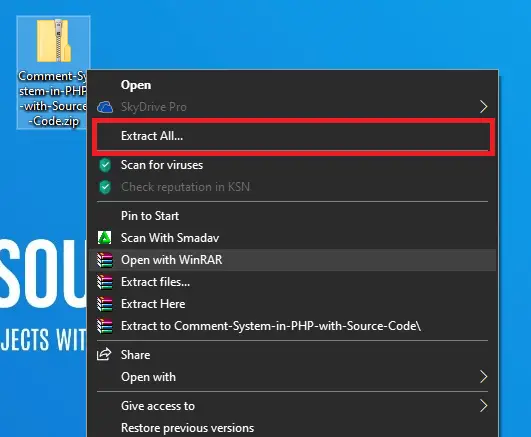
- Step 2: Extract file.
Second, after you finished download the source code, extract the zip file.

- Step 3: Copy project folder.
Third, copy the project folder and paste it into the xampp/htdocs folder.

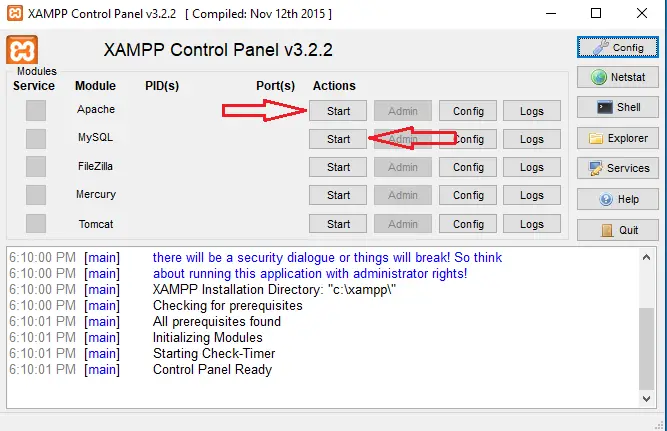
- Step 4: Open xampp.
Fourth, open xampp and start the Apache and MySQL.

- Step 5: Open browser.
Fifth, Open a browser and go to URL “http://localhost/phpmyadmin/

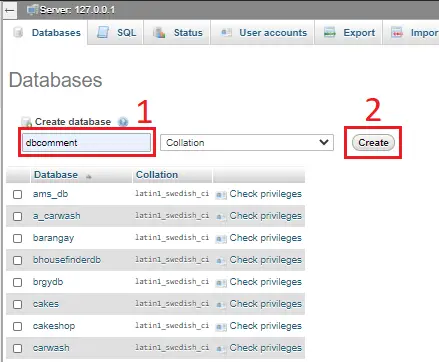
- Step 6: Create database.
Sixth, click on databases tab and Create database naming “dbcomment”.

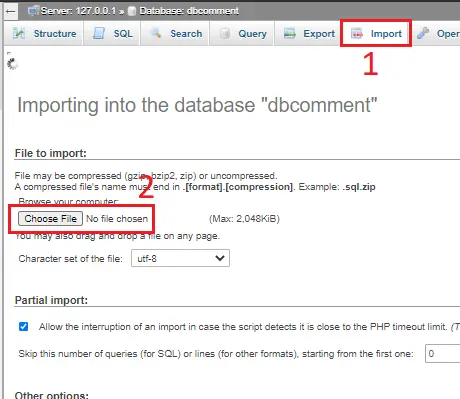
- Step 7: Import
Seventh, Click on browse file and select “dbcomment.sql” file which is inside “comment” folder and after import click “go“.

- Step 8: Open browser and type folder name.
Eight, Open a browser and go to URL “http://localhost/comment/”.





Downloadable Source Code
Conclusion
This comment system is only a project made for school requirement purposes only.
You can download this source code and modify it to suit your client requirements, since this is a student project it means you cannot really expect 100% functionality from this.
Technology stack and requirements
To run this PHP project, you need these tools on your development machine:
- XAMPP or WAMP server. Bundles Apache, MySQL, and PHP so you can run PHP on Windows without individual installs. Free from apachefriends.org.
- PHP 8.0 or higher. Included with XAMPP. Older versions (5.x, 7.x) may work but modern PHP features improve security and performance.
- MySQL or MariaDB. Comes with XAMPP. phpMyAdmin manages the database through a browser UI.
- VS Code or PhpStorm. Free code editor with PHP syntax highlighting, IntelliSense, and debugging support.
- Web browser. Chrome, Firefox, or Edge for testing the running app.
Installing the source code
- Download the archive. Get the ZIP file from the download link on this page and extract it.
- Move to htdocs. Place the extracted folder inside C:\xampp\htdocs\ so Apache can serve it.
- Import the database. Open http://localhost/phpmyadmin, click Import, and select the .sql file included in the archive.
- Update database credentials. Open the config.php or connection.php file and set the correct database name, username, and password (default XAMPP: root / empty password).
- Run the project. Start Apache + MySQL in XAMPP, then visit http://localhost/your-project-folder/ in a browser.
Using this project for your BSIT capstone
This PHP project maps cleanly to standard BSIT capstone documentation. Suggested chapter alignment:
- Chapter 1 (Introduction). Discuss the problem the system solves in real-world context. Cite Philippine business or academic use cases where a manual process could be replaced.
- Chapter 2 (Review of Related Literature). Compare this system’s features against 5-10 similar published projects. Cite journals like IJERT or IEEE Access for academic-standard sources.
- Chapter 3 (Methodology). Include Use Case Diagram, Data Flow Diagram, Entity Relationship Diagram, and Activity Diagram covering all major workflows.
- Chapter 4 (Results and Discussion). Screenshot each module of the running system with a caption explaining what data it processes and which user role interacts with it.
- Chapter 5 (Conclusion and Recommendations). Identify features that could be added in a Version 2, such as mobile app, REST API export, or AI-powered analytics.
Modules typical of Comment System
- Master data. CRUD forms for the primary entities with search and filter.
- Transaction processing. Data entry forms for day-to-day operations the system automates.
- Reports. Formatted printable output summarizing activity per day, user, or category.
- User management. Login with role-based permissions (Admin, Encoder, Viewer).
- Backup and restore. Export database to a .sql file and restore when needed.
Common enhancements for capstone review
- Modernize the UI. Add Bootstrap 5 or Tailwind CSS for a polished appearance.
- Add printable receipts. Use TCPDF or FPDF to generate PDF reports.
- Multi-user concurrency. Ensure database handles simultaneous writes without lost-update errors.
- Rewrite in Laravel. Migrate to Laravel for maintainability and modern development patterns.
Official documentation
Frequently Asked Questions
How does this PHP project work?
Built with vanilla PHP (no framework) and MySQL backend. Standard structure: form HTML, PHP script handlers, MySQL via PDO or mysqli, sessions for auth, Bootstrap for responsive layout. Ready to extend for BSIT capstone scope.
What PHP and MySQL versions does this project require?
Most projects in this batch run on PHP 7.4 to PHP 8.2 with MySQL 5.7+ or MariaDB 10+. A few older projects need PHP 5.6 (deprecated, use XAMPP 7.x). To run: install XAMPP / WAMP / Laragon, extract project to htdocs, import the included .sql file via phpMyAdmin, edit the connection file (usually config.php or db_connect.php) with your DB credentials, browse to the project URL in your browser.
How do I set up the database for this PHP project?
Open phpMyAdmin (http://localhost/phpmyadmin/ on XAMPP), create a new empty database with the name specified in the project’s config.php. Click the Import tab, choose the included .sql file, click Go. Then edit config.php (or includes/connection.php) with: ‘localhost’, your MySQL username (usually ‘root’), your MySQL password (usually blank for XAMPP), and the database name.
Can I use this PHP project for a BSIT capstone or thesis?
Yes, but extend it. A bare CRUD app is too narrow for full capstone scope. Add: user roles via session checks, reports/dashboards (Chart.js + AJAX), PDF exports (TCPDF library), email notifications (PHPMailer), real domain extension (analytics, audit log, multi-branch support). Pair with Chapter 1-5 documentation matching your panel’s rubric.
Why am I getting ‘connection error’ or ‘undefined function mysqli_connect’?
Three common PHP issues: (1) Connection error: Apache + MySQL services not running in XAMPP control panel, OR database name in config.php does not match what you created in phpMyAdmin. (2) ‘undefined function mysqli_connect’: MySQL extension not enabled, in php.ini uncomment extension=mysqli (then restart Apache). (3) ‘No such file or directory’: MySQL socket path wrong, use 127.0.0.1 instead of localhost in the connection string.
Where can I find more PHP projects with source code?
Browse the PHP Projects hub for the full library (300+ vanilla PHP systems). For modern PHP MVC alternatives see Laravel Projects (74 systems) or CodeIgniter Projects (32 systems). For BSIT-focused capstone idea lists see 150 Best Capstone Project Ideas.
Related PHP Projects
- Posting Updates Comment Facebook PHP MySQL
- Content Management System In PHP With Source Code
- Hotel Management System In PHP With Source Code
- Stock Management System In PHP With Source Code
- Message System In PHP With Source Code
- Farm Management System In PHP With Source Code
Inquiries
If you have any questions or suggestions about comment system using php and ajax, please feel free to leave a comment below.

Adrian Mercurio
Full-Stack Developer at PIES IT Solution
Specializes in building complete capstone projects with full documentation. Strong background in PHP/MySQL development and database design. Has personally built and tested over 30 capstone-ready projects with ER diagrams, DFDs, and chapter-by-chapter thesis documentation.
Expertise: PHP · Laravel · Database Design · Capstone Projects · C# · C · C++ · Python · AI Projects
· View all posts by Adrian Mercurio →
Thanks for provding a really simple solution and also provide a souce code.
hiii
kii
appreciate for give us a complete solotion
Thanks
tks bro
I absolutely loved reading your blog! Your articles are well-written and enjoyable, definitely a great read. I bookmarked your page so I can come back and read more lately. Keep up the good work, can’t wait to see more amazing content from you!
https://espirittech.com/php-development/
Thank you for supporting us.
This was a wonderful post being shared. The entire content in this blog is extremely helpful for me and gave me a clear idea of the concepts.
https://espirittech.com/dot-net-application-development-company/
I am impressed by the information that you have on this blog. It shows how well you understand this subject.
https://espirittech.com/codeignitor-development-services/
hi
test
I think it’s great that you included all the points in this article. It shows that you’ve done your research and are committed to providing accurate information.