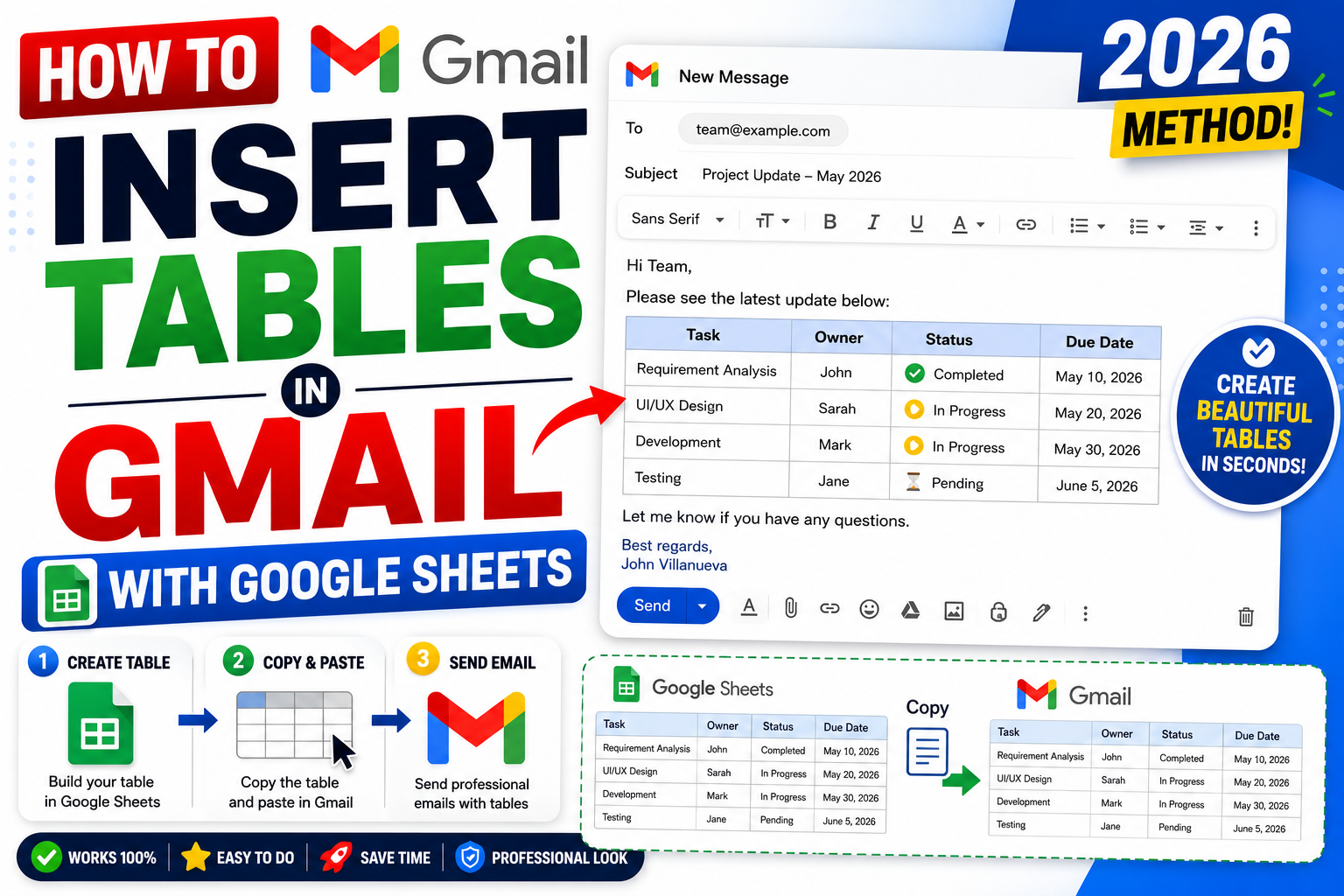
Gmail does not include a native Insert Table button in its compose toolbar. To add a table to a Gmail email, you copy from Google Sheets or Google Docs and paste into the compose window. Gmail preserves the table formatting during paste. This 2026 guide covers the exact steps for both Sheets and Docs source paths, plus tips on styling tables for maximum email compatibility.
Once you have your first table paste working, you can build styled data grids for reports, comparison charts, and structured content that renders across every modern email client.
Why Gmail does not include a native table tool
Understanding the constraint saves time hunting for a button.
- Gmail compose is deliberately simple for fast on-the-fly writing.
- Advanced features like Insert Table were left out to keep the interface responsive on mobile devices.
- Google Sheets and Google Docs both have full table editors, so Gmail relies on paste for the same capability.
- Every table you paste renders correctly in Gmail on desktop, mobile, and most email clients.
Method 1: Copy a table from Google Sheets
Best for data-heavy tables with numbers or calculations.
- Open
sheets.google.comand create a new sheet or open an existing one. - Fill in your table data with headers and rows.
- Format cells: apply borders (Format > Borders), colors (Fill color), and bold headers.
- Select the range of cells that make up your table.
- Press Ctrl+C (Cmd+C on Mac) to copy.
- Open Gmail Compose and place your cursor where the table should go.
- Press Ctrl+V (Cmd+V) to paste. Gmail preserves the table.
Method 2: Copy a table from Google Docs
Best for tables with mixed content (text, links, styled cells).
- Open
docs.google.com. - Click Insert > Table and pick the size.
- Fill in the table cells with your content.
- Style with the toolbar: bold, italic, cell background color, borders.
- Select the entire table (click a table cell, then Ctrl+A twice).
- Copy (Ctrl+C).
- Paste into Gmail Compose (Ctrl+V).
Method 3: Paste HTML table via extension
Power users can inject raw HTML tables for pixel-perfect control.
- Install a Chrome extension that lets you paste raw HTML into Gmail (search “HTML paste Gmail”).
- Write your HTML table code with inline styles for colors, borders, and padding.
- Copy the HTML.
- In Gmail Compose, use the extension’s paste-as-HTML shortcut.
- The table renders exactly as your HTML specified.
Style tables for email compatibility
A few practices ensure tables render well across email clients.
- Use inline styles rather than CSS classes. Email clients often strip external CSS.
- Keep tables under 600 pixels wide. This is the standard email width for desktop viewing.
- Use border-collapse: collapse for clean single-border tables.
- Test with dark mode by setting explicit background colors on cells.
- Add cellspacing=”0″ and cellpadding=”6″ for consistent spacing.
Basic table structure that always works
The minimum HTML for a solid email table.
- Wrap in
<table>with cellspacing=”0″ and cellpadding=”6″. - Header row uses
<th>with a background color like#1F3A5Fand white text. - Data rows use
<td>with alternating background colors for readability. - Borders on
<td>for a clean grid look. - Copy this structure from Google Docs and paste for a starting template.
Common table insertion mistakes
- Copying from Excel or Word. Word and Excel HTML is heavier than Docs or Sheets, sometimes with unpredictable results. Prefer Google Docs or Sheets as source.
- Making the table too wide. Tables over 600 pixels wide overflow on mobile. Keep under 600 for desktop-first, under 400 for mobile-first.
- Ignoring dark mode. Some email clients dark-mode content automatically. Set explicit background colors on cells so styling stays intact.
- Complex nested tables. Tables inside tables get inconsistent across clients. Keep tables flat.
- Not testing on Outlook. Outlook has quirky HTML rendering. Test any important table in Outlook before sending.
When tables are worth using in email
Tables shine for structured data: comparisons, pricing grids, feature lists, or metrics. Any content where the reader needs to compare rows benefits from tabular format.
For casual conversation or simple lists, tables are overkill. Bullet points or numbered lists are cleaner and render more consistently.
For marketing emails, use tables sparingly. Most modern email design has moved away from complex tables to responsive layouts. Consider whether the content really needs tabular presentation.
For business reports (weekly updates, KPI summaries), tables are the right tool. Consistency across a team’s reports helps everyone read faster.
Power-user tips for tables in Gmail
- Save styled tables as Gmail Templates. Once you have a table format you like, save the entire email as a template and reuse.
- Include a caption or title above. “Q3 Sales Numbers” makes the table’s purpose clear at a glance.
- Use zebra stripes. Alternating light-gray rows make wide tables easier to scan.
- Bold column headers. Distinguishes headers from data at a glance.
- Test on real recipients. Send yourself the table on multiple devices (desktop, iPhone, Android) to confirm it renders correctly.
Best practices for tables in professional email
Tables communicate structured data faster than any other format. A few conventions keep them readable across every email client.
- Keep tables under 600 pixels wide. Standard email view width for desktop clients. Prevents mobile overflow.
- Bold column headers. Distinguishes headers from data at a glance.
- Alternate row backgrounds. Zebra stripes with light gray make wide tables scannable.
- Use inline styles. Email clients strip external CSS. Every style must be inline on the element.
- Test in Outlook. Outlook has quirky table rendering. Any important table needs an Outlook test before sending.
- Include a title above. “Q3 Sales by Region” makes the table’s purpose clear at a glance.
Official documentation
Recommended email productivity resources
The links below are affiliate links. We may earn a commission at no extra cost to you when you buy or sign up. See our affiliate disclosure.
Frequently Asked Questions
Does Gmail support inserting tables?
Not natively. You copy from Google Sheets or Google Docs and paste. Gmail preserves the table formatting during paste.
Will pasted tables render for all recipients?
Yes, most modern email clients (Gmail, Outlook 2016+, Apple Mail, Yahoo) render HTML tables correctly. Very old Outlook 2007 may have layout issues.
Can I edit the table after pasting into Gmail?
Basic edits work: click a cell and type. Structural changes (add columns, rows) require going back to the source in Sheets or Docs and re-copying.
Do tables from Excel work when pasted?
Yes, Gmail accepts Excel copies and converts to HTML table. However, Google Sheets is more reliable for consistent rendering.
Can I use HTML directly to insert a table?
Only if you enable a Chrome extension that lets you paste raw HTML. Gmail’s default compose strips
tags for security.How wide should my email table be?
Under 600 pixels for standard desktop email view. Under 400 pixels for mobile-first design. Tables wider than 600px overflow on mobile screens.

Glay Eliver
Programmer & Technical Writer at PIES IT Solution
Glay Eliver is a programmer and writer at PIES IT Solution, author of over 600 tutorials at itsourcecode.com.
Expertise: JavaScript · MS Excel · MS Word · MS PowerPoint · Python · Python ImportError · View all posts by Glay Eliver →
Looking for similar projects or tutorials?
Search for more source code, capstone projects, or programming tutorials
