
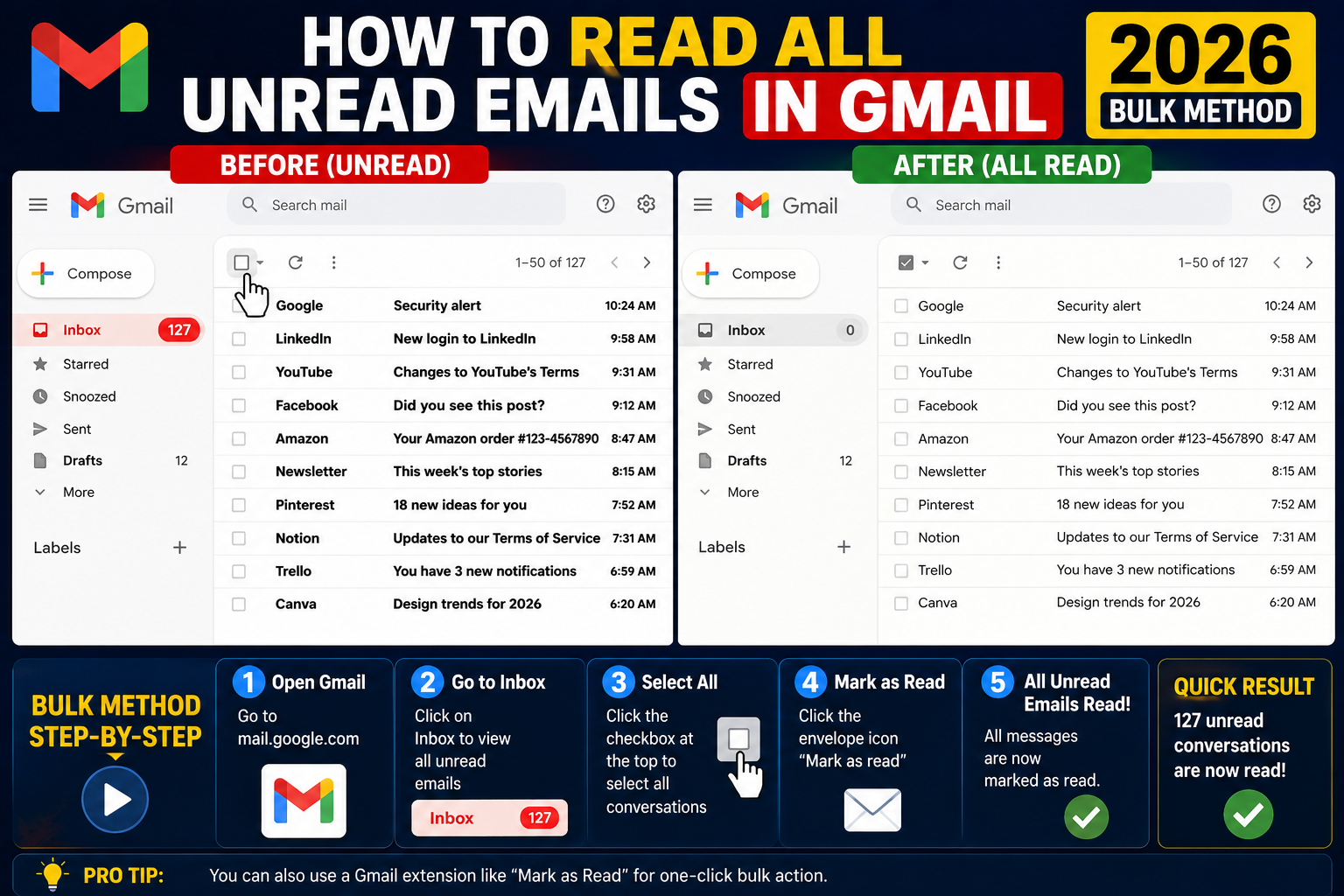
When you have hundreds or thousands of unread emails, Gmail lets you mark them all as read in one bulk action. The trick is using the search operator is:unread to filter the view first, then selecting all matching emails at once. This 2026 guide covers the exact click sequence on desktop and mobile, plus how to narrow the bulk action by sender, label, or date.
The whole operation takes about 30 seconds once you know the sequence, no matter how many unread emails you have.
Understand the is:unread search operator
The bulk mark-as-read pattern relies on Gmail’s search filtering. The is:unread operator narrows your view to only unread messages.
- Type
is:unreadin the Gmail search bar to see only unread emails in your inbox. - Combine with other operators:
is:unread from:notifications@github.comfilters to GitHub notifications only. - Use
label:inbox is:unreadto filter to unread emails in a specific label. - The operator is your foundation for all bulk actions. Once filtered, selecting all covers only the matched emails.
Mark all unread emails as read on desktop
The full sequence takes three clicks after the search filter is active.
- Type
is:unreadin the Gmail search bar and press Enter. - Gmail shows only unread emails, hiding all others.
- Click the select-all checkbox at the top left of the email list (next to the trash icon).
- A banner appears saying “All 50 conversations on this page are selected.” Click Select all conversations that match this search to extend selection beyond the visible page.
- Click the Mark as read button (an open envelope icon) in the toolbar above the email list.
- Gmail confirms the action with a small popup showing how many conversations were marked. All unread emails are now read.
Mark all unread emails as read on mobile
The mobile app supports the same pattern with taps instead of clicks.
- Open the Gmail app on iPhone or Android.
- Tap the search bar at the top and type
is:unread. - Tap the profile picture (or first email) with a long-press to enter selection mode.
- Tap Select all in the top bar.
- Tap the three-dot menu and choose Mark as read.
- Confirm the bulk action. All emails matching the search become read.
Undo the mark-as-read action
Accidentally marked emails read? Gmail’s Undo feature works for a few seconds after the action.
- Immediately after marking, look at the bottom of the Gmail interface for the yellow Undo button.
- Click Undo within about 10 seconds to reverse the action.
- If you missed the window, mark them unread again with the same select-all + Mark as unread sequence (envelope icon with a dot).
- Or search
is:read after:2025/06/15(with today’s date) to find recently-marked emails and toggle them back.
Narrow the bulk action by sender, label, or date
Combining is:unread with other operators lets you mark subset of unread emails read while leaving others alone.
is:unread from:notifications@github.com– only GitHub notifications.is:unread label:promotions– only Promotions tab.is:unread older_than:30d– only unread emails older than 30 days (great for cleanup).is:unread has:attachment– only unread emails with attachments.- Combine multiple:
is:unread from:linkedin.com older_than:60dfor stale LinkedIn notifications.
Common bulk mark-as-read mistakes
- Forgetting to click Select all conversations. The default select-all only picks the visible page (50 emails). The banner link at the top extends to all matching conversations.
- Marking as read when you meant to delete. Mark as read (envelope icon) is different from Delete (trash icon). Read the tooltip before clicking.
- Not using a filter operator to narrow. Marking ALL unread emails read can hide important messages you have not seen. Use
is:unread from:senderto be selective. - Confusing read status with archived status. Marking as read keeps emails in Inbox. Archiving moves them out. Choose the right action for your goal.
- Missing the 10-second Undo window. The bulk action affects thousands of emails but Undo has a short window. Keep hands off the mouse until Undo appears.
When bulk mark-as-read is worth doing
Most users benefit from a monthly cleanup of unread notifications, promotional emails, and stale newsletters. Search is:unread older_than:30d and mark them all read. This clears the visual noise from your inbox count without deleting anything.
For inbox-zero enthusiasts, combine bulk mark-as-read with bulk archive for a fresh start. Search is:unread, mark all as read, then search -is:starred -label:important older_than:7d and archive them. Your inbox becomes just recent important emails.
For team accounts (shared inboxes, alerts), automate with Gmail filters. Create a filter that auto-applies “Skip Inbox” (which archives) plus “Mark as read” for known low-priority senders. Manual bulk action becomes unnecessary.
Power-user tips for managing unread
- Use keyboard shortcuts. Enable Gmail keyboard shortcuts, then press Shift+I to mark selected emails read (or Shift+U for unread).
- Star before marking. If some unread emails need action, star them first. The star survives mark-as-read so you can find them later.
- Create Priority Inbox. Settings > Inbox > Inbox Type > Priority Inbox. Gmail machine-learns which senders are important and shows them separately from noise.
- Build a Filters strategy. Auto-label incoming email so cleanup becomes filter-based (Bulk Mark Promotions as read) instead of ad-hoc.
- Check unread count via URL. Bookmark
mail.google.com/mail/u/0/#search/is:unreadto jump directly to your unread view without typing the search.
Best practices for keeping unread count low
The most sustainable inbox strategy is preventing unread build-up in the first place. Every filter you create, every notification you unsubscribe from, and every sender you route out of the inbox reduces the volume you have to manually manage.
- Unsubscribe aggressively. Legitimate newsletters have an unsubscribe link. Use it for any newsletter you have not read in 3 months.
- Turn off app notifications for non-critical services. GitHub, Slack, and Jira send tons of email. Configure their notification settings to send only mentions and direct messages.
- Batch process email twice a day. Instead of checking Gmail constantly, dedicate 15-minute blocks morning and afternoon. Faster and less anxiety-inducing.
- Follow the two-minute rule. If an email takes less than 2 minutes to reply, do it now. Otherwise archive with a snooze until you have time.
Official documentation
Recommended email productivity resources
The links below are affiliate links. We may earn a commission at no extra cost to you when you buy or sign up. See our affiliate disclosure.
2026 Q4 update: faster bulk-read methods added this year
Google shipped two meaningful bulk-management improvements to Gmail in 2026 that make the standard “select all and mark as read” flow faster for most readers.
Keyboard shortcut now ships enabled by default. The Shift + I shortcut marks every selected message as read in one keystroke. Before 2026 this required manually enabling keyboard shortcuts under Settings. New Gmail accounts now have shortcuts on by default. Combine it with * then a (select all) and Shift + I to clear thousands of unread emails in two keystrokes.
Mobile bulk-select got the long-press expansion. On iOS 19 Gmail and Android 16 Gmail, long-pressing any email now shows “Select all above” and “Select all below” options in the toolbar. Tap one, then tap the three-dot menu, then “Mark as read”. Much faster than the old approach of tapping each message individually.
Google Workspace admin bulk tool (for business accounts). If you administer a Workspace tenant, the admin console at admin.google.com gained a bulk-management panel in August 2026 that lets you mark all unread for any user without that user needing to sign in. Useful for shared mailboxes or when onboarding/offboarding.
For personal Gmail users, the keyboard shortcut method is the fastest. Enable shortcuts if you have an older account (Settings → See all settings → General → Keyboard shortcuts: On), then * a Shift+I handles any inbox size in seconds.
Frequently Asked Questions
Can I mark all unread emails as read in one click?
Not one click, but three total clicks (search is:unread, select all, mark as read). The whole sequence takes about 30 seconds regardless of how many unread emails you have.
Does marking as read delete the emails?
No. Marked-as-read emails stay in your inbox and folders. Only the visual unread indicator disappears. To remove them from view, use Archive or Delete instead.
Can I undo mark-as-read?
Yes, within about 10 seconds. Look for the yellow Undo button at the bottom of the Gmail interface after the bulk action. Beyond that window, you would need to search and mark them unread manually.
Will bulk mark-as-read affect emails on my phone?
Yes. Gmail syncs read status across all devices within seconds. Marking on desktop shows the change on iPhone or Android almost immediately.
Can I mark unread emails from a specific sender only?
Yes. Combine the operators: is:unread from:notifications@github.com. Then select all matching and mark as read. Only the specific sender’s unread emails are affected.
How do I stop constant unread noise in the first place?
Set up Gmail filters that auto-apply Skip Inbox and Mark as read for known low-priority senders. This is the sustainable pattern. Bulk mark-as-read is a monthly cleanup, filters are the daily automation.
Gmail bulk read updates in 2026
Google added a keyboard shortcut for “Mark all as read” in Gmail’s web interface in March 2026. Press “g” then “a” to jump to the All Mail folder, then press “*” then “u” to select all unread, then press “Shift+I” to mark them all as read. This chain works even on inboxes with tens of thousands of unread messages, though it can take 30 to 60 seconds for Google to process the bulk update on very large inboxes.
For iOS and Android Gmail apps in 2026, the “Mark all as read” button is still buried inside the label view (open a label, tap the three dots, then “Mark all as read”). Google added it as a floating action button in the beta channel, so expect this to become easier in the general release later in 2026.
If you are trying to zero out an inbox that has been ignored for years (10,000 plus unread), the fastest method in 2026 is Gmail’s advanced search: type “is:unread older_than:6m” in the search bar, then select all results, then mark as read. This spares your recent unread messages while clearing the historical clutter.
A cleaner long term approach: enable Google’s “Priority Inbox” feature, which automatically bubbles important unread messages to the top and treats everything else as background noise. Once enabled, you can safely ignore the total unread count on your other labels and only focus on the “Important” section. This is what most Google engineers use internally per their engineering blog posts across 2025 and 2026.