

In Python programming, developers often encounter different error messages while working on regular expressions. One of the error messages is the “ValueError: Pattern Contains No Capture Groups“.
This error usually occurs when a regular expression pattern does not consist of any capture groups.
Why does this Valueerror pattern contains no capture groups error occur?
This Valueerror pattern contains no capture groups error occurs when we try to use a regular expression pattern that does not contain any capture groups.
How the Error Reproduce?
This is an example of how the error occurs:
import pandas as pd
example_data = [['Jacob', 'Romeo'],
           ['Rolandita', 'Alvina'],
           ['Kimmy','Kassandra']]
datavalue_sample = pd.DataFrame(data=example_data, columns=['A', 'B'])

result = datavalue_sample['A'].str.extract('Jacob')
print(result)
Output:
Traceback (most recent call last):
File “C:\Users\Dell\PycharmProjects\Python-Code-Example\main.py”, line 7, in
result = datavalue_sample[‘A’].str.extract(‘Joe’)
File “C:\Users\Dell\PycharmProjects\Python-Code-Example\venv\lib\site-packages\pandas\core\strings\accessor.py”, line 129, in wrapper
return func(self, *args, **kwargs)
File “C:\Users\Dell\PycharmProjects\Python-Code-Example\venv\lib\site-packages\pandas\core\strings\accessor.py”, line 2593, in extract
raise ValueError(“pattern contains no capture groups”)
ValueError: pattern contains no capture groups
In the example code above, the error in your code is occurring because the str.extract() method expects a regular expression pattern as an argument, but you’re providing a string literal (‘Jacob’) instead.
Solutions to Fix the ValueError Pattern Contains No Capture Groups
Here are the following solutions to fix the ValueError Pattern Contains No Capture Groups error.
Solution: Used the str.contains() method
To resolve this value error is by using the str.contains() method and extract the rows that consist of the string ‘Jacob’ in column ‘A’.
Here’s an example code:
import pandas as pd

example_data = [['Jacob', 'Romeo'],
           ['Rolandita', 'Alvina'],
           ['Kimmy','Kassandra']]
datavalue_sample = pd.DataFrame(data=example_data, columns=['A', 'B'])

result = datavalue_sample[datavalue_sample['A'].str.contains('Jacob')]
print(result)
Output:
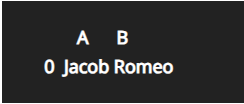
In this updated code, I’ve used the str.contains() method instead of str.extract() to check if the value ‘Jacob’ exists in each row of column ‘A’.
The str.contains() method returns a Boolean Series showing that whether the given pattern is found in each element of the Series.
By using datavalue_sample[‘A’].str.contains(‘Jacob’), we reach a Boolean Series that determine the rows where ‘Jacob‘ is present in column ‘A’.
Finally, we pass this Boolean Series as a filter to the DataFrame datavalue_sample, choosing only the rows that gratify the condition, and assign the result to the variable result. Printing result will give you the desired output.
FAQs
The error occurs when the regular expression pattern used does not contain any capture groups.
Capture groups in regular expressions are portions of the pattern enclosed within parentheses (). They allow you to extract specific parts of the matched string.
Yes, non-capturing groups can be used instead of capture groups when you don’t need to extract the matched substrings separately.
No, capture groups are not necessary for all regular expressions. They are only required when you need to extract specific parts of the matched string.
Python ValueError debugging checklist
- Read the full traceback. The message often names the exact value that failed.
- Print repr(value) before the failing call — shows quotes, whitespace, and hidden chars.
- Check library version. Many ValueErrors come from API changes across pandas / numpy / sklearn versions.
- Guard at boundaries. Wrap risky conversions in try/except and provide sensible defaults.
- Use pydantic or dataclasses. Modern validation catches ValueError at input time with clean error messages.
Common ValueError sources across libraries
- Conversion failures. int(“abc”), float(“$100”), datetime.strptime with wrong format.
- Shape/length mismatches. pandas assignment, numpy arithmetic, sklearn fit input.
- Iterable unpacking. Too many or not enough values.
- JSON parsing. Malformed JSON strings.
- Domain-specific validation. Custom validators that raise ValueError on invalid input.
Modern tooling to prevent ValueError
- pydantic v2. Runtime validation with clean error messages.
- dataclasses with __post_init__. Validate at construction time.
- argparse type=. Auto-convert and validate CLI args.
- FastAPI request models. Web boundary validation without your code touching raw input.
- polars strict types. Catches type/value issues at load time.
Official documentation
Frequently Asked Questions
What is Python ValueError and what causes it?
ValueError is raised when a function receives an argument of the right TYPE but an invalid VALUE. Example: int(‘abc’) gets a string (right type for the function) but the value ‘abc’ can’t be parsed as int. Other common cases: math.sqrt(-1), datetime.strptime with wrong format string, json.loads on malformed JSON, pandas.to_datetime on unparseable dates.
How do I fix ‘invalid literal for int() with base 10’?
int() couldn’t parse your string as a number. Three fixes depending on cause: (1) strip whitespace + newlines first: int(s.strip()). (2) Decimal numbers need float() then int(): int(float(‘3.14’)). (3) For ‘sometimes a number, sometimes blank’ use try/except ValueError: try: n = int(s) except ValueError: n = 0.
What is the difference between ValueError and TypeError?
TypeError: wrong type passed to a function (int + str). ValueError: right type but invalid value (int(‘abc’)). Both are common; catching them together is a common boundary pattern: except (TypeError, ValueError) as e: handle_bad_input(e). For internal code, distinguish them: TypeError usually means a real bug, ValueError can be expected on bad user input.
How do I prevent ValueError when parsing user input?
Three layers: (1) Validate before parsing (regex check that string looks numeric before int()). (2) Use Pydantic / Marshmallow for structured input. (3) Always have a try/except ValueError fallback at API boundaries. Combine all three for production-grade input handling.
Where can I find more ValueError fixes?
Browse the ValueError reference hub for 100+ specific fixes (pandas, NumPy, sklearn, TensorFlow, datetime parsing). For related errors see TypeError. For Python tutorial coverage see Python Tutorial hub.
Conclusion
The Pattern Contains No Capture Groups error is encountered when a regular expression pattern lacks capture groups.
In this article, we discussed an example that triggers this error and provided a solution to resolve it.

Adones Evangelista
Programmer & Technical Writer at PIES IT Solution
Adones Evangelista is a programmer and writer at PIES IT Solution, author of over 900 tutorials and error-fix guides at itsourcecode.com. Specializes in JavaScript, Django, Laravel, and Python error debugging covering ValueError, TypeError, AttributeError, ModuleNotFoundError, and RuntimeError, plus C/C++ and PHP capstone projects for BSIT students.
Expertise: JavaScript · Python · Django · Laravel · Error Debugging · C/C++
· View all posts by Adones Evangelista →