

When working with DataFrames, it is not inevitable that you may encounter a common error known as “ValueError: DataFrame constructor not properly called“.
This error typically occurs when the incorrect arguments are passed to the DataFrame constructor.
Understanding the ValueError: DataFrame Constructor Error
The “ValueError: DataFrame constructor not properly called” error is occur when the DataFrame constructor isn’t provided with the correct arguments or when the arguments are not in the expected format.
This error shown that there is a problem with the way you are attempting to create a DataFrame object.
What Causes the ValueError: DataFrame Constructor Not Properly Called?
Here are the possible common causes of the ValueError: DataFrame Constructor Not Properly Called.
- Missing Data Input
- Mismatched Data Dimensions
- Incorrect Data Format
How the Error Occur?
Here’s an example code of how the error occurs:
import pandas as pd
data_sample = "Welcome to Dataframe Contructor"
result = pd.DataFrame(data_sample)
print(result)
Output:
Traceback (most recent call last):
File “C:\Users\Dell\PycharmProjects\Python-Code-Example\main.py”, line 3, in
result = pd.DataFrame(data_sample)
File “C:\Users\Dell\PycharmProjects\Python-Code-Example\venv\lib\site-packages\pandas\core\frame.py”, line 817, in init
raise ValueError(“DataFrame constructor not properly called!”)
ValueError: DataFrame constructor not properly called!
Solutions to Fix the ValueError: DataFrame Constructor Not Properly Called
To fix the ValueError: DataFrame Constructor Not Properly Called. Here are the following solutions you need to appy.
Method 1: Providing Sufficient Data and Column Labels
One of the common reasons for encountering the ValueError is insufficient or missing data input.
To solve this, make sure that you provide the necessary data and column labels when creating the DataFrame.
Let’s take a look at an example:
import pandas as pd
data_sample = {'Name': ['Ryan', 'Jessa', 'Ronaldo'],
        'Age': [21, 29, 25],
        'City': ['Manila', 'Cebu', 'Makati']}
result = pd.DataFrame(data_sample)
print(result)
Output:
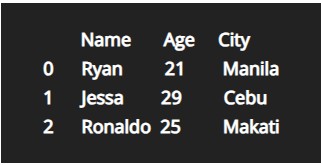
In this example, we create a DataFrame using the provided data dictionary, which includes the ‘Name’, ‘Age’, and ‘City’ columns.
By passing the data dictionary to the pd.DataFrame() function, we successfully create a DataFrame without encountering the ValueError.
Method 2: Ensuring Consistent Data Dimensions
Another reason that can lead to the ValueError is inconsistent data dimensions.
To prevent this issue, make sure that the dimensions of your input data align correctly.
Here’s an example code:
import pandas as pd

sample_names = ['Joven', 'Janine', 'Rose']
sample_ages = [23, 36, 25]
sample_cities = ['Boston', 'Denver', 'Portland']

sample_data = {'Name': sample_names,
        'Age': sample_ages,
        'City': sample_cities}

result = pd.DataFrame(sample_data)
print(result)
Output:
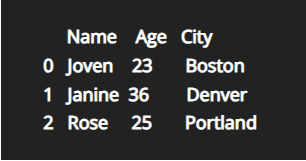
In this example code, we specified the three separate lists for the ‘Name‘, ‘Age‘, and ‘City‘ columns.
By ensuring that the lengths of these lists are the same, we can avoid the ValueError. Pandas will match the corresponding elements from each list to create the DataFrame.
Method 3: Verifying Data Format
Ensuring that the input data is in the expected format is important to avoid the “ValueError” error.
Let’s take an example code:
import pandas as pd

sample_data = [('Rey', 29, 'Austin'),
        ('Rudy', 32, 'Atlanta'),
        ('Rambo', 36, 'Dallas')]

sample_columns = ['Name', 'Age', 'City']

result = pd.DataFrame(sample_data, columns=sample_columns)
print(result)
By defining the column labels through the columns parameter, we successfully create the DataFrame without encountering the ValueError.
Frequently Asked Questions
To fix this error, ensure that you provide sufficient data and column labels, check that the data dimensions are consistent, and make sure the input data is in the expected format.
No, column labels are essential for creating a pandas DataFrame. Each column must have a unique label to identify its contents accurately.
Yes, apart from using dictionaries, you can create a DataFrame from other data structures, such as NumPy arrays, CSV files, Excel files, or databases.
Pandas provides functions like pd.read_csv(), pd.read_excel(), and pd.read_sql() for this purpose.
Conclusion
The “ValueError DataFrame constructor not properly called” error is a common issue encountered by users while working with pandas DataFrames.
By understanding the possible causes and applying the solutions provided in this article, you can resolve this error and continue your data analysis tasks easily.
Additional Resources
Pandas ValueError patterns
Pandas ValueErrors usually come from shape mismatches, dtype issues, or attempting operations on rows/columns of incompatible lengths.
Common triggers
- Length mismatch on assignment.
df["new_col"] = [1, 2, 3]when df has 5 rows raises ValueError. - Cannot convert non-finite values to int. NaN in a numeric column raises ValueError on astype(int). Fill NaN first:
df["col"].fillna(0).astype(int). - Merge on mismatched columns. Merging on differently-typed key columns (int on one side, str on the other) raises ValueError.
- Read CSV column type inference. Mixed types in a column cause dtype ValueError. Use
dtype=parameter explicitly. - groupby.agg with wrong callable. Custom agg functions returning wrong shape raise ValueError.
Diagnostic pattern
# BAD — mixed int and str in the same column
df = pd.read_csv("data.csv")
df["id"] = df["id"].astype(int)   # ValueError if any cell is empty or non-numeric

# GOOD — coerce with default
df["id"] = pd.to_numeric(df["id"], errors="coerce")  # bad values become NaN
df["id"] = df["id"].fillna(0).astype(int)
Best practices
- Use pd.to_numeric / pd.to_datetime with errors=”coerce”. Bad values become NaN — no ValueError.
- Check df.dtypes before operations. Silent dtype mismatches cause most pandas ValueErrors.
- Use Series.astype with pandas nullable types. Int64, boolean nullable types handle NaN cleanly.
- Consider polars. Strict typing catches these issues at load time.
Official documentation

Adones Evangelista
Programmer & Technical Writer at PIES IT Solution
Adones Evangelista is a programmer and writer at PIES IT Solution, author of over 900 tutorials and error-fix guides at itsourcecode.com. Specializes in JavaScript, Django, Laravel, and Python error debugging covering ValueError, TypeError, AttributeError, ModuleNotFoundError, and RuntimeError, plus C/C++ and PHP capstone projects for BSIT students.
Expertise: JavaScript · Python · Django · Laravel · Error Debugging · C/C++
· View all posts by Adones Evangelista →
Frequently asked questions
How do you fix ValueError in pandas?
Most pandas ValueErrors come from length mismatches (comparing DataFrames of different shapes), invalid types in operations, or missing values. Check df.shape, df.dtypes, and df.isnull().sum() first.
What is the difference between ValueError and TypeError?
TypeError fires when the type is wrong (adding int + str). ValueError fires when the type is correct but the value is not accepted (int(‘abc’) is str + str behavior but the value ‘abc’ cannot be parsed to int).
How do you catch ValueError in Python?
Wrap the risky call in try/except ValueError. Provide a fallback value or re-raise with more context. Never use bare ‘except:’ — that catches SystemExit and KeyboardInterrupt too.
Should you use validation libraries to prevent ValueError?
Yes. pydantic v2 and dataclasses with __post_init__ can validate at boundaries. For CLI arguments, argparse’s type= parameter converts and validates. For web APIs, FastAPI’s request models catch invalid input before your code runs.
What tools help debug ValueError?
The full traceback shows the exact line, print(repr(value)) shows the actual received value including whitespace, and pydantic + type hints catch many ValueErrors statically before runtime.