

The Hotel Management System Class Diagram is a designed diagram the shows the system’s relationships and classes. The Class Diagram is made to guide programmers along with the Hotel management system development.
It contains the class attributes, methods as well as the relationships between classes. These mentioned contents makes sure that your Hotel management system development must inline with what should be its functions.
Hotel Management System Class Diagram Design Considerations.
You should know that a Hotel Management system is a set of software programs that keep things running smoothly in a hotel. The situation makes a big difference in how productive and efficient the hotel is.
Hotels’ main job is to give travelers a place to stay, food, drinks, and other services and goods on a commercial basis. They offer things that people usually have at home but can’t get when they’re away from home.
The system’s target must be at improving the day-to-day status of admission/vacation of residents, list of workers, payment information, and so on.
The main goal of this project is to give a solution for hotels to use computerized processes to manage the majority of their operations.
How to Construct Hotel Management System Class Diagram?
Now to create the UML class diagram for hotel management system, you will first determine the classes. So the classes that must be made in a Hotel are the reservations, users, customers, rooms, employees transaction.
The mentioned classes were just general. If you want more complex or wider scope of your Hotel Management System, then you can add your desired classes. You must also include the database on your Class Diagram for your system.
Free tool
Generate this Class Diagram in 3 minutes
You have the structure. Now build it with your own entities. The Booking / Reservation template comes pre-filled, so you rename what does not match your project and export straight into your Chapter 3.
Open the Booking / Reservation template →3 free diagrams every week. No credit card needed.
Class Diagram for Hotel Management System Construction
Here, I will be showing you the sample constructed Hotel management System Class Diagram. It was provided with its attributes with matching methods. This is constructed with the simple idea derived from the common function of a Hotel System.
The illustration shown in this article gives you the hint on how will you design your own Hotel Management System UML Class Diagram. It has the simple idea on how the class Diagram works.
It resembles a flowchart in which classes are represented as boxes with three rectangles inside each box. The top rectangle has the class’s name; the middle rectangle contains the class’s properties; and the bottom rectangle contains the class’s methods, commonly known as operations.
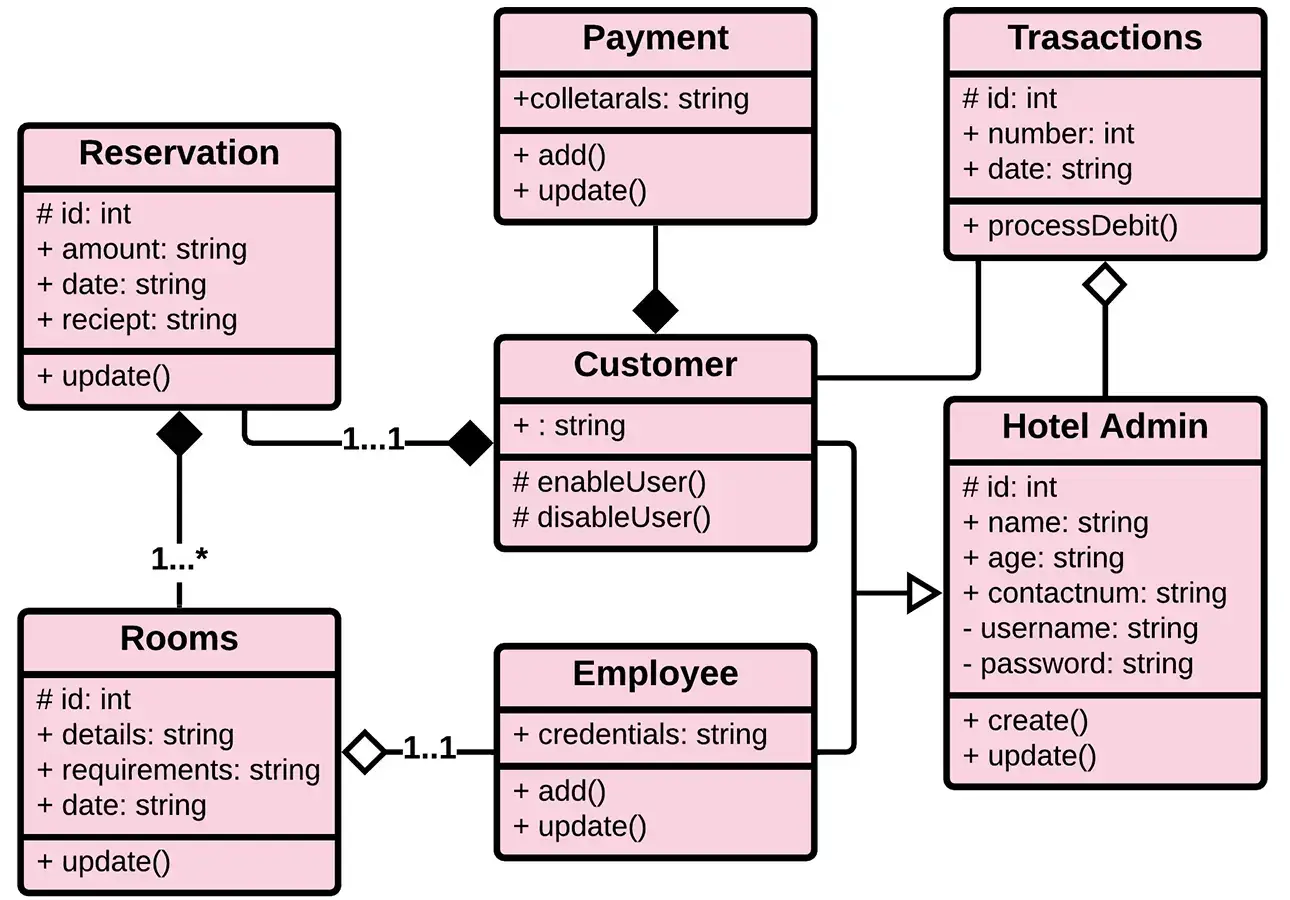
As you can see through the illustration, the classes were determined which is symbolized by boxes. They were designated with their corresponding attributes and shows the class’ methods.
Their relationships are also plotted to show the connections between classes and their multiplicity. Just bear in mind that when you create your own class diagram, you have to be specific.
That is because, it will affect your project development. Do not worry because you can use the sample given as your project reference or you may also create your own.
Tips on UML Class Diagram of Hotel Management System
To design your Class diagram, you may use platforms and editing tools online. These tools are helpful since they already have the needed symbols to illustrate your class diagram.
You just have to plot the included actors and objects. Then you will put the appropriate messages that the system requires.
Conclusion
The Class Diagram for Hotel Management System is a modeled diagram that explain its classes and relationships. The diagram depicts the names and attributes of the classes, as well as their links and, their methods.
It is the most essential type of UML diagram which is critical in software development. It is an approach to show the system’s structure in detail, including its properties and operations.
The Hotel Management System must have a designed diagram to define the classes needed for the desired outcome. It is used to model the items that make up the system, depict their relationships, and define what those objects perform and the services they provide.
Aside from that, you can learn more about Diagrams by reading the linked and suggested articles below.
- Activity Diagram for Hotel Management System
- Hotel Management System UML Diagrams
- Use Case Diagram for Hotel Management System
- ER Diagram for Hotel Management System
- Component Diagram for Hotel Management System
Inquiries
Now let me ask you something. What have you learned through the discussion?
May this article help you with your projects in the future!
If you have inquiries or suggestions about Hotel Management System Class Diagram | UML just leave us your comments below.
Keep us updated and Good day!
Working hotel management source code that implements this diagram
The diagram above defines the flows; these are the actual hotel management systems on itsourcecode.com that implement them. Pick one in your team’s stack and you have a working reference to point your panel at when they ask “show me where this flow actually runs in code.”
Want to customize this class diagram for your capstone?
Open the Hotel Management System template in CapstoneUML. Drag, rename, add relationships, then export as PNG, SVG, PowerPoint, or PDF for your Chapter 3 documentation.

PHP: Online Hotel Management System in PHP
Vanilla PHP + MySQL. Guest, Room, Booking, Payment classes map directly to MySQL tables.

Java: Hotel Management System in Java
Java Swing + JDBC. Each UML class becomes a .java file with constructor + getters/setters.

ASP.NET: Online Hotel Management in ASP.NET
C# + SQL Server. Entity Framework models mirror your class diagram entities.

VB.NET: Monbela Hotel Management in VB.NET
VB.NET + MS Access. Classic Windows Forms with one form per class in your UML.

Django (Python): Django Hotel Management System
Django 4 + Bootstrap. Django models = your UML class diagram in Python.

Laravel (PHP): Online Hotel Booking in Laravel
Laravel + Eloquent. Each Eloquent model maps one-to-one with a class in your diagram.
How to use this for your Chapter 3 (Methodology): download the project in your stack, then map each process and data store in this diagram to a specific module, controller, or table in the downloaded source. That mapping IS the bridge between your design chapter and your implementation chapter, the single thing panels want to see traced end to end.
How to read a class diagram
A class diagram has three components in each class box: name (top), attributes (middle), operations/methods (bottom). Relationships between classes are shown as lines with different symbols.
- Association. Plain line means two classes know about each other.
- Inheritance / Generalization. Line with a hollow arrowhead pointing to the parent class.
- Realization. Dashed line with hollow arrowhead pointing to an interface.
- Aggregation. Line with a hollow diamond at the “whole” end (e.g., Department has Employees).
- Composition. Filled diamond at the “whole” end (e.g., House is composed of Rooms).
- Dependency. Dashed arrow: one class uses another temporarily.
Cardinality notation
- 1. Exactly one
- 0..1. Zero or one (optional)
- 1..*. One or more (mandatory + many)
- 0..* or *. Zero or more (any number)
- 1..5. Between 1 and 5
Common capstone mistakes to avoid
- Missing cardinality. Every association must have numbers on both ends.
- Getters/setters listed as separate methods. Show only meaningful business methods; getters/setters are implied.
- Utility classes. Do not clutter the diagram with String, Date, etc.
- No visibility modifiers. Use + (public), – (private), # (protected) on attributes and methods.
- Confusing aggregation vs composition. Composition means the part cannot exist without the whole.
Where the class diagram fits in Chapter 3
- Section 3.2 (Object-Oriented Analysis and Design). The class diagram is usually placed here.
- Reference from the ER diagram. Show how database tables map to classes.
- Reference from the use case diagram. Each use case triggers operations on one or more classes.
- Include a legend. Explain the notation for panel members who may not remember UML conventions.
Official documentation
Working source code for this system
Download the actual implementation of this system in your preferred language. Each project includes source code, database, and setup instructions for BSIT capstone use.
- PHP: Online Hotel Management System Project In PHP
- VB.NET: Monbela Hotel Management System Project Using VB.Net and MS Access Version 2.0.0
- Java: Hotel Management System Project in Java With Source Code
- Python: Django Hotel Management System With Source Code
- Django: Django Hotel Management System With Source Code
- Laravel: Hotel Management System Project in Laravel With Source Code
Skip the redraw: grab the Hotel Management System template
Class, Use Case, ER, DFD, Activity, and Sequence diagrams already filled in with capstone-ready entities and flows. Free preview, no card required.
Frequently asked questions
What is a class diagram used for in BSIT capstone?
A class diagram shows the static structure of the system: classes, attributes, methods, and relationships (inheritance, association, aggregation, composition). It goes in Chapter 3 of the capstone documentation and communicates the object-oriented design of the system.
What tool should I use to draw the class diagram?
Free options: draw.io (browser-based, saves to Google Drive), Lucidchart free tier, PlantUML (text-based, version-controllable), StarUML (30-day trial then reduced feature set), Visual Paradigm Community Edition. Paid options: Microsoft Visio, Lucidchart pro, Enterprise Architect. For BSIT capstones, draw.io is the most commonly used free tool.
How detailed does the class diagram need to be for capstone defense?
Panel members expect the diagram to match the actual system implementation. Include every major class/use case/entity relevant to the system. Omit trivial helper classes. Every diagram element should have a clear justification. Aim for 1-2 diagrams that fully cover the system, not many partial ones.
Should I use black-and-white or colored diagrams?
Black-and-white is standard for capstone documentation to match the thesis format. Use color only if it improves clarity (e.g., grouping subsystems). Ensure text is readable at printed size (10pt minimum for labels).
Where does this diagram go in the capstone documentation?
Chapter 3 (System Design and Methodology) typically holds all UML diagrams. Introduce each diagram with a 1-paragraph description explaining what it shows and how to read it. Reference specific elements in the surrounding text so panel members can follow the design rationale.

Mary Grace G. Patulada
Programmer & Technical Writer at PIES IT Solution
Mary Grace G. Patulada (pen name ‘Nym’) is a programmer and writer at PIES IT Solution with a BSIT background from Carlos Hilado Memorial State College, Binalbagan Campus. Authored 370+ UML diagram tutorials and capstone documentation guides at itsourcecode.com. Specializes in UML (class, use case, activity, sequence, component, deployment), DFD, and ER diagrams for BSIT capstone projects.
Expertise: UML Diagrams · DFD · ER Diagrams · Use Case Diagrams · Activity Diagrams · Capstone Documentation · PHP
· View all posts by Mary Grace G. Patulada →