
Are you struggling right now to fix this “typeerror a bytes like object is required not str” error message in Python?
In this article, we’ll delve into how to troubleshoot this “typeerror a bytes-like object is required not ‘str’” error message that you encounter.
This is because we understand that it might be hard for you.
If you don’t know what this error means or why it occurs in your code, that needs to be resolved.
So, what we did was compile all the important details that will help you fix this “python typeerror a bytes like object is required not str” error.
What is a bytes-like object in Python?
A bytes-like object in Python is a sequence of bytes that can be used in place of a bytes object.
This includes objects like bytearray, memoryview, and io.BytesIO.
What is “typeerror a bytes like object is required not str”?
The “typeerror a bytes-like object is required not ‘str’” is an error message in Python.
That occurs when you are trying to pass a string to a function or method that expects a bytes-like object.
Such as:
→ bytearray
→ memoryview
→ certain types of buffers
This error message indicates that the function or method that you are using requires a bytes object or a bytearray object instead of a string.
Furthermore, this error can happen when you are working with binary files or network sockets.
For example:
message = "Itsourcecode!"
message_bytes = message.encode('utf-8')

file = open("file.txt", "wb")
file.write(message)
file.close()
As a result, it will throw an error message.
TypeError: a bytes-like object is required, not 'str'To fix this error, you may need to convert your string to a bytes-like object using the appropriate method or function, such as bytes() or encode().
To resolve this error we just the replace “file.write(message)” with “file.write(message_bytes)” as you can see below:
message = "Itsourcecode!"
message_bytes = message.encode('utf-8')

file = open("file.txt", "wb")
file.write(message_bytes)
file.close()
What are the root causes of the “typeError a bytes-like object is required, not str” error?
The following are the common root causes of this “Python a bytes like object is required not str” error:
✔ Encoding and decoding errors
This error can occur when you are trying to encode or decode data using the wrong method or encoding type.
✔ Working with binary data
This error can also happen when you try to work with binary data, such as files or network sockets, and you pass a string instead of a bytes-like object.
✔ Mismatched data types
Also include if you are passing a string to a function that expects a different data type, such as an integer or a float.
How to fix the “typeerror a bytes like object is required not str”
After you understand this error thoroughly, let’s jump into the solutions.
Here are the different solutions you may use to fix the “typeerror a bytes-like object is required not ‘str’” error:
1. Use encode method appropriately
Use the encode() method to convert the string to bytes.
mystring = "Itsourcecode!"
mybytes = mystring.encode()


print(mybytes)
Output:
b'Itsourcecode!'2. Use bytes() function
Use the bytes() function to convert the string to bytes.
mystring = "Itsourcecode!"
mybytes = bytes(mystring, "utf-8")

print(mybytes)
Output:
b'Itsourcecode!'3. If you have a file you are trying to read or write, open it in binary mode (“rb” for reading and “wb” for writing)
Example code for reading:
with open("file.txt", "rb") as f:
    contents = f.read()
    decoded_contents = contents.decode()
    print(decoded_contents)
The example code opens a file named “file.txt” in binary mode for reading and assigns it to the variable f.
Output:
Welcome to Itsourcecode!
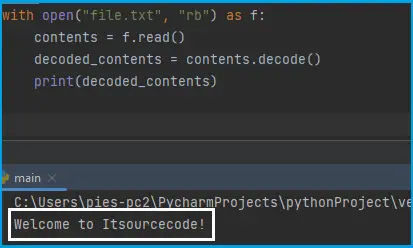
Here’s the complete code and the result:
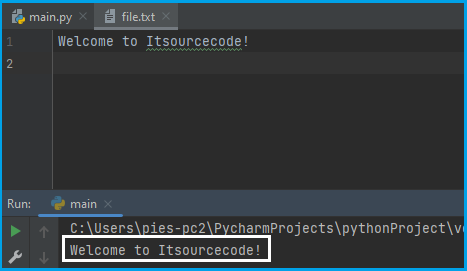
Here’s the file.txt and the result:
Example code for writing:
message = "Itsourcecode!"
message_bytes = message.encode('utf-8')

file = open("file.txt", "wb")
file.write(message_bytes)
file.close()
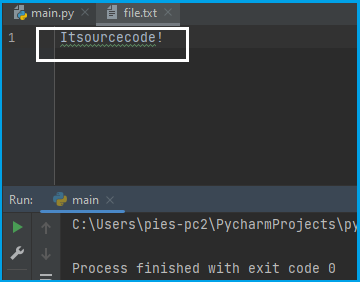
Output:
4. Converting a string to bytes using the encode() method when trying to concatenate bytes-like objects
If you are trying to concatenate bytes-like objects, make sure that all of them are bytes-like objects. You can convert a string to bytes using the encode() method:
my_bytes = b"It, "
my_string = "sourcecode!"
my_bytes += my_string.encode()

print(my_bytes)
Output:
b'It, sourcecode!'Note: In general, the solution to this “bytes-like object is required, not ‘str’” error is to make sure that you are working with the correct data type.
Conclusion
By executing the different solutions that this article has already given, you can easily fix the “TypeError: a bytes-like object is required, not ‘str’” error message while working with Python.
We are hoping that this article provides you with sufficient solutions.
You could also check out other “typeerror” articles that may help you in the future if you encounter them.
- Typeerror unsupported operand type s for dict and dict
- Typeerror: this.clienginector is not a constructor
- Typeerror byte indices must be integers or slices not str
Thank you very much for reading to the end of this article.
Understanding int/str/float TypeErrors
Python separates numeric types from strings strictly. Concatenating, comparing, and arithmetic across type boundaries requires explicit conversion.
Common triggers
- User input is always str.
input()always returns str. Wrap withint()orfloat(). - CSV cells are all str. Even numeric-looking columns are strings until converted.
- JSON numbers vs str. json.loads preserves the JSON type — but only “123” as string in the JSON becomes str in Python.
- Format string mismatch.
"%d" % "5"raises TypeError. Useint("5")first. - Compare int and str. Python 3 fails on
"1" < 2. Convert one side first.
Diagnostic pattern
# BAD — user input treated as int
age = input("Enter your age: ")
if age >= 18:  # TypeError: '>=' not supported between 'str' and 'int'
    print("Adult")

# GOOD — convert first, guard failure
try:
    age = int(input("Enter your age: "))
except ValueError:
    print("Invalid age")
    age = 0

if age >= 18:
    print("Adult")
Best practices
- Convert at boundaries. Convert input, config values, and API responses to the right type immediately after loading.
- Use pydantic or dataclasses. Modern data validation libraries convert and check types automatically.
- Avoid == across types. Compare like-to-like.
Official documentation
Frequently Asked Questions
What is Python TypeError and what causes it?
TypeError is raised when an operation is applied to an object of the wrong type. Common patterns: calling a non-callable object, adding incompatible types (str + int), passing the wrong number of arguments, or accessing attributes on a NoneType. Each TypeError message names the operation and expected vs actual types, the fix is almost always to convert types explicitly (int(), str()) or fix the wrong variable assignment.
How do I quickly debug a Python TypeError?
Three steps: (1) Read the full error message, it names the exact operation and types involved. (2) Print the type of every variable in that line: print(type(var1), type(var2)). (3) Check what the function expected vs what you passed. Most TypeError fixes are 1-line type casts or fixing a variable that became None unexpectedly.
Should I catch TypeError or let it propagate?
For internal code, let TypeError propagate, it’s almost always a real bug (wrong type passed). For boundary code (parsing user input, third-party API responses), catch TypeError + ValueError together: try: parsed = int(value) except (TypeError, ValueError): parsed = 0. Catching internal TypeErrors hides bugs.
How do I prevent TypeError in production?
Three patterns: (1) Use type hints (def add(a: int, b: int) -> int) and check with mypy / pyright in CI. (2) Validate inputs at boundaries (Pydantic for FastAPI, DRF serializers for Django). (3) Default values that match expected types (return 0 not None for numeric functions). Static typing catches 80% of TypeErrors before runtime.
Where can I find more TypeError fixes?
Browse the TypeError reference hub for 220+ specific TypeError fixes. For broader Python debugging, see the Python Tutorial hub. For related error types, see ValueError and AttributeError guides.

Caren Bautista
Technical Writer at PIES IT Solution
Responsible for crafting clear, well-structured, and beginner-friendly content across the platform. Handles the writing, proofreading, and editorial review of tutorials, guides, and documentation to ensure every article is accurate, readable, and easy to follow.
Expertise: Technical Writing · Content Creation · Documentation · Editorial Writing · JavaScript · TypeScript · Python · Python Errors · HTTP Errors · MS Excel
· View all posts by Caren Bautista →