
![No module named 'sklearn.linear_model.logistic' [SOLVED]](https://itsourcecode.com/wp-content/uploads/2023/03/modulenotfounderror-no-module-named-sklearn.linear_model.logistic.png)
Running into modulenotfounderror: no module named ‘sklearn.linear_model.logistic’ is a high probability when you are a developer.
But don’t worry, we’re here to assist you in fixing that error.
In this article, we will show you how to solve the modulenotfounderror: no module named ‘sklearn.linear_model.logistic’ in Python.
This error occurs when we attempt to import the logistic regression module from the scikit-learn library, but it is not installed in our system.
What is Python?
Python is one of the most popular programming languages.
It is used for developing a wide range of applications.
In addition, Python is a high-level programming language that is used by most developers due to its flexibility.
Returning to our issue, we must take a few actions to fix this error.
So, without further ado, let’s move on to our “how to fix this error” tutorial.
How to solve “no module named ‘sklearn.linear_model.logistic’” in Python
Here’s how to resolve the modulenotfounderror: no module named ‘sklearn.linear_model.logistic’ in Python:
Install the scikit-learn package.
Resolving the error modulenotfounderror: no module named ‘sklearn.linear_model.logistic' is an easy task.
All you have to do is install the scikit-learn package.
To install this package, open your cmd or command prompt, then input the command:
pip install -U scikit-learnThe command pip install -U scikit-learn will download and install the ‘scikit-learn’ module on your system.
If you’re using Python 3, use the command pip3 install -U scikit-learn.
Alternative Solution
If the error still exists, try this alternative solution:
Reinstall the scikit-learn package.
To do so, follow the steps below.
- Uninstall the scikit-learn package.
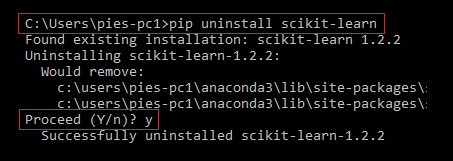
To uninstall the scikit-learn package, input the pip uninstall scikit-learn command, then press the Enter key.
After inputting the pip uninstall scikit-learn command, results will come out, and this question will also appear (Proceed (Y/n)?).
Once that appears, just type Y, then click the Enter key.

- Install the scikit-learn package.
After uninstalling the scikit-learn package, install it again.
To do so, enter the pip install -U scikit-learn command.
Commands you might need
- pip list
This command will display all the packages installed on your system, including their versions.If you’re using Jupyter Notebook, use the !pip list command.
However, if you’re using Anaconda, use the command conda list.
- python -m
Include this command in your pip install -U scikit-learn command if you get an error message stating that “pip” cannot be found.Example: python -m pip install -U scikit-learn
- pip install –upgrade pip
Use this command to upgrade the pip package manager to its newest version.If your pip is already in the latest version, this will come out: “Requirement already satisfied.”
- python –version
Use this command if you want to check what version of Python you have.
Conclusion
In conclusion, the modulenotfounderror: no module named ‘sklearn.linear_model.logistic’ can be easily solved by installing the scikit-learn package in your system.
By following the guide above, there’s no doubt that you’ll be able to resolve this error quickly.
We hope you’ve learned a lot from this.
Thank you for reading, and have fun coding!
Related Python Tutorials
- Modulenotfounderror No Module Named Sklearn Jupyter Solved
- Modulenotfounderror No Module Named Torch Solved
- Solved Python No Module Named Error
- Modulenotfounderror No Module Named Attrdict Solved
- Modulenotfounderror No Module Named Mlxtend Solved
- Modulenotfounderror No Module Named Gensim Solved
Root causes of No module named ‘sklearn.linear_model.logistic’
- Package not installed. The module you’re importing was never installed in the current environment. Fix: pip install <package-name>.
- Wrong virtual environment active. You installed in one venv but running from a different environment. Verify with which python and which pip.
- Multiple Python versions. pip installs for one Python, but you’re running a different version. Use python -m pip install <package> to force it.
- Typo in module name. Case-sensitive imports. Beautiful_Soup vs beautifulsoup4 vs bs4. Check the actual import name in the package docs.
- Package uninstalled or corrupted. Try pip install –force-reinstall <package> to freshen the install.
Step-by-step debugging
- Verify Python path. import sys; print(sys.executable) shows which Python is running.
- Check installed packages. pip list | grep <package> confirms it’s actually installed.
- Match environment. Confirm the terminal that ran pip install is the same environment your code runs in.
- Reinstall cleanly. pip uninstall <package> then pip install <package>.
- Try python -m install. python -m pip install <package> avoids PATH mismatches.
Working install pattern
# Create fresh environment (recommended for any new project)
python -m venv myenv
source myenv/bin/activate  # Windows: myenv\Scripts\activate

# Install requirements
pip install --upgrade pip
pip install <package-you-need>

# Verify install
pip list | grep <package>
python -c "import <package>; print(<package>.__version__)"
When the error persists
- Check for typos. Module names can differ from PyPI names (opencv-python vs cv2, beautifulsoup4 vs bs4).
- Update Python or downgrade the package. Some packages have version-specific compatibility.
- Restart the interpreter or kernel. Jupyter and IDEs cache import state.
- Check for conda/pip conflicts. If using Anaconda, prefer conda install <package> over pip.
Debugging Python code effectively
- print() with context. Add variable names and types: print(f”user_id={user_id} type={type(user_id)}”)
- pdb / breakpoint(). Call breakpoint() anywhere to drop into interactive debugger.
- VS Code debugger. Set breakpoints in the editor, run F5, step through with F10.
- logging over print. import logging; logging.debug() is toggleable and thread-safe for production.
- Read full tracebacks. The bottom-most line usually shows what happened; the stack shows how you got there.
Modern Python tooling
- uv. Ultra-fast package installer and resolver (10-100x faster than pip). Standard in 2026.
- ruff. Fast linter + formatter (replaces flake8, black, isort in one binary).
- mypy. Type checker. Add types incrementally to catch bugs at design time.
- pytest. Standard test framework. Simpler than unittest.
- rich. Beautiful terminal output for CLI tools.
Where to go next after this tutorial
- Learn a web framework. Django for full-stack apps; FastAPI for APIs; Streamlit for data dashboards.
- Study a data library. pandas for data analysis; polars for large-scale processing; DuckDB for embedded SQL analytics.
- Practice with real projects. Browse itsourcecode.com Python Projects for 250+ capstone-ready systems (LLM apps, ML models, chatbots, dashboards).
- Read PEP 20 (Zen of Python). import this in an interpreter to see 19 lines of Python philosophy.
Official documentation
Frequently Asked Questions
What Python version does this tutorial target?
How do I install Python for this tutorial?
Do I need pip and virtual environments?
Can I use this in a Jupyter notebook or Google Colab?
Where can I find more Python practice projects?

Elijah Galero
Programmer & Technical Writer at PIES IT Solution
Elijah Galero is a programmer and writer at PIES IT Solution, author of 175+ tutorials at itsourcecode.com. Specializes in Python error debugging (AttributeError, TypeError, ModuleNotFoundError), Python programming tutorials, and Microsoft Excel how-to guides for BSIT students and productivity learners.
Expertise: Python · Python Errors · Python AttributeError · Python TypeError · ModuleNotFoundError · MS Excel · MS PowerPoint
· View all posts by Elijah Galero →