
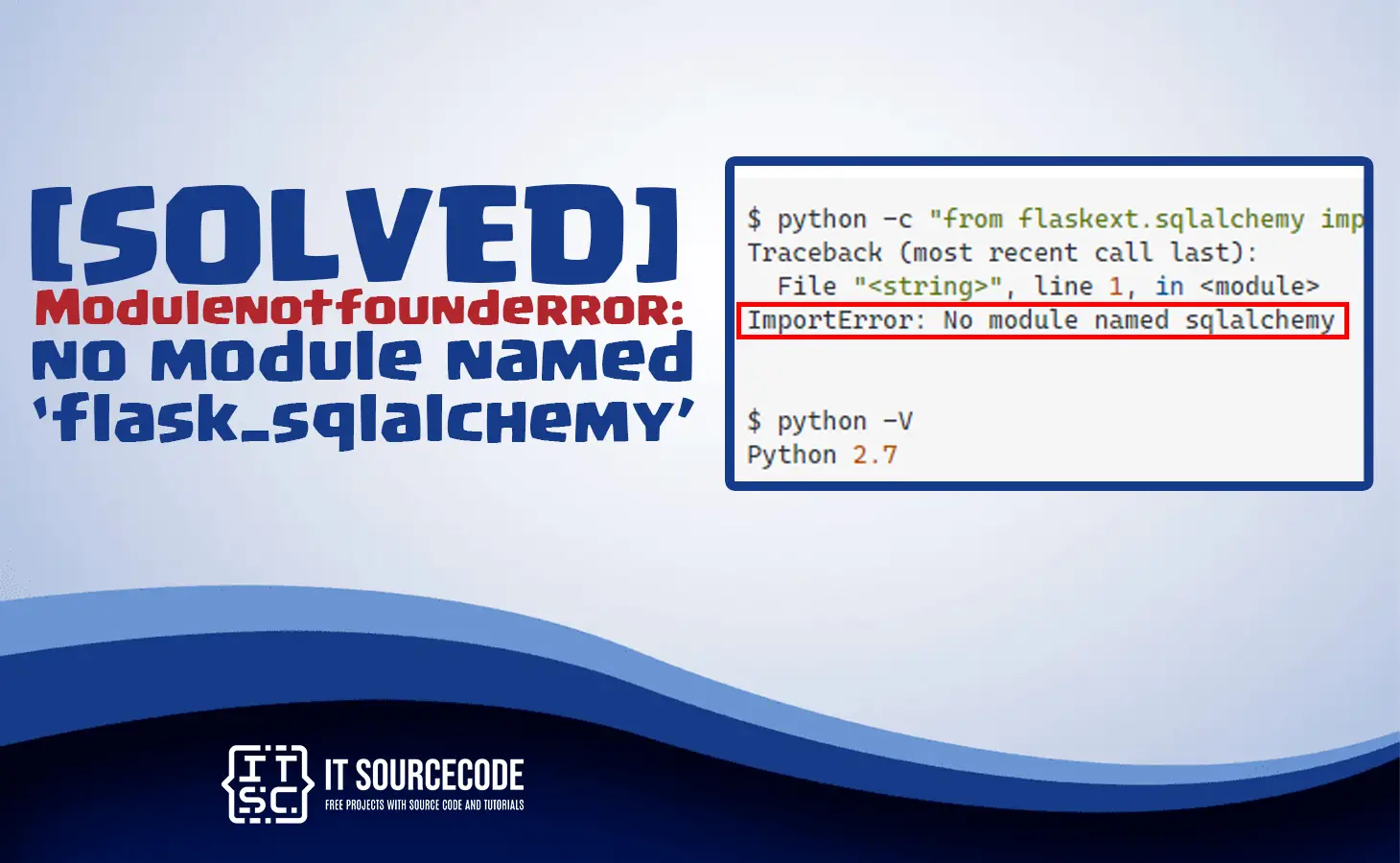
In this tutorial, we will cover how to fix Modulenotfounderror: no module named flask_sqlalchemy error.
Along with we will briefly discuss what are the causes and understand what module is this.
When developing applications with Python, Flask is one of the most popular frameworks to use.
It is simple, lightweight, and provides the essential features needed for web development.
However, when working with Flask, you may encounter an error message that says “ModuleNotFoundError: No module named ‘flask_sqlalchemy’”.
So let’s get started!
What is flask_sqlalchemy module?
Flask-SQLAlchemy is a module for the Flask web framework that provides an easy-to-use interface for working with relational databases using SQLAlchemy.
Additionally, SQLAlchemy is a Python library that provides a high-level, object-oriented interface for working with databases.
Flask-SQLAlchemy allows you to define your database schema using Python classes, and it provides a set of tools for querying, updating, and managing your database data.
It also includes support for advanced features such as migrations, relationships between tables, and database transactions.
What is Modulenotfounderror: no module named ‘flask_sqlalchemy’?
ModuleNotFoundError: No module named ‘sqlalchemy’ is an error in Python that raise when we forget to install the SQLAlchemy module before importing it or installing it in an incorrect environment.
How to fix Modulenotfounderror: no module named ‘flask_sqlalchemy’
The following are the steps on how to resolve the error message stating modulenotfounderror: no module named flask_sqlalchemy in Python.
- Check if the flask_sqlalchemy module is installed
First, you need to check if the flask_sqlalchemy module is installed in your Python environment or system.
To check, open the cmd or command prompt, then type the command pip list.
The command pip list will show you the list of installed modules on your system.
Moving on, if the flask_sqlalchemy module is not found, move to the next step.
However, if the flask_sqlalchemy module is already installed, skip the next steps and proceed to the tip below. - Install flask_sqlalchemy module
If the module is not installed, you need to install it in order to fix it.
Try the following command below in your terminal:
The command for virtual environment or using Python 2
pip install SQLAlchemy Flask-SQLAlchemy
If you are using python 3
pip3 install SQLAlchemy Flask-SQLAlchemy
If you’re getting a permissions error
sudo pip3 install SQLAlchemy Flask-SQLAlchemy
pip install SQLAlchemy Flask-SQLAlchemy –user
Command if you don’t have pip in your PATH environment variable
python -m pip install SQLAlchemy Flask-SQLAlchemy
If you are using python 3 it could also be pip3.10 depending on your version
python3 -m pip install SQLAlchemy Flask-SQLAlchemy
If you are using py alias Windows OS
py -m pip install SQLAlchemy Flask-SQLAlchemy
The command for Jupyter Notebook
!pip install SQLAlchemy Flask-SQLAlchemy - Fix the Path
After you installed the module but the error continues.
This is more likely the pip is installed but in the wrong path.
This is the reason why the script can’t locate it.
To fix this error follow the steps we will provide below.
Step 1: Open the folder where you installed your Python by using this command, where python.
Step 2: Copy the location of the Script folder after you browse and open it. Make sure it contains the pip file.
Step 3: In the command prompt open the script directory using the cd command and the location copied previously.
Step 4: Now install the module using the command pip install flask_sqlalchemy. - Check python version
Confirm that you’re using the right Python version that has the
flask_sqlalchemy
To do so, you can check your Python version by inputting python –version into your command prompt.
The command python –version will display the version of Python installed on your system.


Reason why we encounter Modulenotfounderror: no module named ‘flask_sqlalchemy’
Having Modulenotfounderror: no module named ‘flask_sqlalchemy’ is due to the following reasons:
- The SQLAlchemy package was not installed by running pip install SQLAlchemy.
- Installing the package in a Python version other than the one you’re currently using.
- Installing the package on a global scale rather than in your virtual environment.
- The IDE running an incorrect version of Python.
- Naming your module sqlalchemy.py which would shadow the official module.
- Declaring a variable named sqlalchemy which would shadow the imported variable.
If the error continues, acquire your Python version and ensure that you are installing the package with the correct Python version.
Other Solutions in fixing Modulenotfounderror: no module named ‘flask_sqlalchemy’
- The modulenotfound error shows because of the relative imports.
- Having different versions of Python and pip in your system. Try this command to fix:
- python3 -m pip install sqlalchemy
- pip3 install sqlalchemy
- pip install sqlalchemy
- Typically facing server-side issue. Try this command:
- pip install –user sqlalchemy
- If you are using Ubuntu, an error may appear so use this command:
- sudo apt install sqlalchemy
Conclusion
In conclusion, Modulenotfounderror: no module named flask_sqlalchemy is an error raised when the Python code is trying to import the “flask_sqlalchemy ” module but it can’t be found.
Either the module is not installed or it’s installed in a location where your Python interpreter is not looking for it.
Remember to always keep your Python installation and modules up to date, and to check for missing dependencies if you encounter any issues.
That’s it we have provided solutions for fixing this error. However, if you follow the steps and encounter any further errors, feel free to ask for more help!
If you are finding solutions to some errors you’re encountering we also have Modulenotfounderror: no module named django_filters.
Official documentation
Frequently Asked Questions
What is Python ModuleNotFoundError and what causes it?
ModuleNotFoundError (a subclass of ImportError) is raised when Python cannot find the module you tried to import. Common causes: the package isn’t installed (pip install missing), wrong virtual environment activated, typo in module name, or Python can’t find your local module on the import path. The error message names exactly which module is missing.
How do I fix ‘ModuleNotFoundError: No module named X’?
Run pip install X first. If that succeeds but you still get the error, check which Python you’re using (which python OR python –version) vs which pip (which pip OR pip –version), they must match. Common gotcha: pip points to system Python 3.9 but you’re running python3.11 in a venv. Inside the venv, use python -m pip install X to be sure pip matches the active Python.
Why does my code work in one environment but not another?
Different Python versions or different installed packages. To diagnose: pip freeze > requirements.txt on the working environment, then pip install -r requirements.txt on the broken one. Use virtualenv (python -m venv venv) or conda for every project to avoid system-wide package collisions.
Is ModuleNotFoundError the same as ImportError?
ModuleNotFoundError is a subclass of ImportError added in Python 3.6. It specifically means ‘no such module exists.’ Plain ImportError covers a wider set: module exists but a name inside it can’t be imported (e.g. ‘cannot import name X from Y’). except ImportError catches both; except ModuleNotFoundError catches only the missing-module case.
Where can I find more ModuleNotFoundError fixes?
Browse the ModuleNotFoundError reference hub for 198+ specific module fixes (TensorFlow, Flask, Django, pandas, numpy, etc.). For related issues see ImportError. For broader Python setup see Python Tutorial hub.

Glay Eliver
Programmer & Technical Writer at PIES IT Solution
Glay Eliver is a programmer and writer at PIES IT Solution, author of over 600 tutorials at itsourcecode.com. Specializes in JavaScript tutorials, Microsoft Office how-tos (Excel, Word, PowerPoint), and Python error debugging covering ImportError, TypeError, AttributeError, ModuleNotFoundError, and JavaScript ReferenceError. Authored several of the site’s highest-traffic Excel and MS Office reference articles.
Expertise: JavaScript · MS Excel · MS Word · MS PowerPoint · Python · Python ImportError · Python TypeError · Python AttributeError · ModuleNotFoundError · JavaScript ReferenceError · Pygame · View all posts by Glay Eliver →