
If you are wondering how to say I love you programmatically, especially in JavaScript. Well, this article got your back!
Discover the creative and unique ways to express your love through code with our comprehensive guide.
Want to impress your loved one with your coding skills? Start to learn to say “I love you” in JavaScript with our step-by-step guide.
Solutions on how to say “I love you” in JavaScript?
Here’s the code to if you wanted to say I love you to someone using JavaScript programming language.
document.write("I love you ❤️!")or
console.log("I love you! ❤️");Output:
I love you! ❤️Here are the different ways on how to say I love you in JavaScript.
Use alert Box
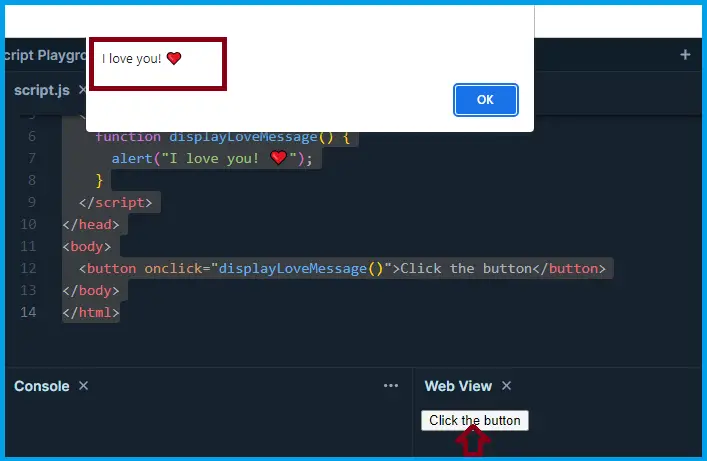
The code alert(“I love you”); will display an alert box with the message “I love you” when executed in a web browser.
Here’s the complete code example:
<!DOCTYPE html>
<html>
<head>
  <title>Example</title>
  <script>
    function displayLoveMessage() {
      alert("I love you! ❤️");
    }
  </script>
</head>
<body>
  <button onclick="displayLoveMessage()">Click the button</button>
</body>
</html>
Output:
Use function
You can make your own functions in JavaScript. So, you can create a special function to show how much you love something or someone.
For example:
function sayILoveYou() {
  console.log("I love you! ❤️");
}

sayILoveYou();
Output:
I love you! ❤️Use variables
In JavaScript, you can use variables to save data. For instance, you can assign the phrase “I love you” to a variable and then show it on the screen.
Here’s a simple example:
var loveMessage = "I love you! ❤️";
console.log(loveMessage);
Output:
I love you! ❤️How to say I love you programmatically in different programming languages?
In this section, you’ll learn to say I love you in various languages.
HTML
To say I love you using HTML, here’s the example code:
<html>
  <head>
    <title>I Love You!</title>
  </head>
  <body>
    <h1> I Love You! from Itsourcecode</h1>
    </body>
</html>
Python
To say I love you using Python, here’s the example code below:
print("I Love You!")
C
To say I love you using C, here’s the example code:
#include<stdio.h>

int main()

{

printf("I Love You! \n");

}
C++
To say I love you using C++, here’s the example code:
#include<iostream>

using namespace std;

int main()

{

cout<<"I Love You!"<<endl;

}
Java
To say I love you using Java, here’s the example code:
public class Main{

public static void main(String[] args){

System.out.println("I Love You!");

}

}
Ruby
puts "I love you"Conclusion
In conclusion, this article discusses and explores how to say “I love you” in JavaScript in various ways.
In JavaScript, there are a few ways to say, “I love you.” You can display the message using document.write(“I love you ❤️!”) or console.log(“I love you! ❤️”).
You can also create a function or use variables to show your affection. Additionally, this article provides examples of saying “I love you” in other programming languages like HTML, Python, C, C++, Java, and Ruby.
We are hoping that this article provides you with enough information that helps you understand JavaScript code I love you.
You can also check out the following article:
- JavaScript rename object keys
- JavaScript function init
- How to iterate over Elements of a Set in JavaScript?
Thank you for reading itsourcecoders 😊.
Common use cases for How to say “I love you”
How to say “I love you” appears in most modern JavaScript codebases. The most frequent patterns:
- Front-end applications. React, Vue, Svelte, and vanilla JS all rely on How to say “I love you” for user interactions and rendering logic.
- Back-end services. Node.js APIs use How to say “I love you” in request handlers, middleware, and data pipelines.
- Utility functions. Small reusable helpers wrap How to say “I love you” to encapsulate common transformations.
- Test suites. Unit tests exercise How to say “I love you” across happy-path and edge-case inputs to lock behavior.
- Configuration handling. Read from environment variables or config files and normalize with How to say “I love you” before use.
Working code example
// A realistic example of How to say “I love you” in production code
function processInput(rawValue) {
  // Guard against unexpected input
  if (rawValue == null) {
    return { ok: false, reason: "empty input" };
  }

  const cleaned = String(rawValue).trim();
  if (cleaned.length === 0) {
    return { ok: false, reason: "whitespace only" };
  }

  return { ok: true, value: cleaned };
}

const result = processInput("  hello world  ");
console.log(result); // { ok: true, value: "hello world" }
Best practices when working with How to say “I love you”
- Use strict mode. Add “use strict” at the top of your files, or use ES modules which are strict by default.
- Prefer const over let. Only use let when you actually reassign. Never use var in new code.
- Add TypeScript. Adopting TypeScript catches many bugs in How to say “I love you” at compile time.
- Write focused functions. Small functions with a single responsibility are easier to test and reason about.
- Add unit tests. Cover the happy path plus edge cases like empty strings, null, undefined, and boundary numbers.
Common pitfalls with How to say “I love you”
- Type coercion surprises. == does implicit conversion. Always use === and !== unless you specifically want coercion.
- Hoisting confusion. Function declarations hoist, but const/let do not. Declare before use.
- this binding. Arrow functions inherit this from the surrounding scope. Regular functions do not. Choose deliberately.
- Silent NaN propagation. Math with a NaN value results in NaN. Guard with Number.isFinite() at boundaries.
Official documentation
Frequently Asked Questions
Is JavaScript still worth learning in 2026?
What is the difference between var, let, and const?
Which JavaScript version should I target in 2026?
What is the best free editor for JavaScript?
How do I run JavaScript locally vs in the browser?
What can I build with JavaScript for my BSIT capstone?

Caren Bautista
Technical Writer at PIES IT Solution
Responsible for crafting clear, well-structured, and beginner-friendly content across the platform. Handles the writing, proofreading, and editorial review of tutorials, guides, and documentation to ensure every article is accurate, readable, and easy to follow.
Expertise: Technical Writing · Content Creation · Documentation · Editorial Writing · JavaScript · TypeScript · Python · Python Errors · HTTP Errors · MS Excel
· View all posts by Caren Bautista →