
Enrollment System Thesis Chapter 4 – Existing System
This article of Enrollment System Thesis Chapter 4 – Existing System or Chapter 4 Enrollment System Thesis Documentation shows the following such as general objectives, specific objectives, scope of the existing system, concept operation, activity diagram and data flow diagram of existing system.(Documentation for Computerized Enrollment System Chapter 4)
The Existing System
General Objectives
The objective of the manual process of enrollment of Ilog Catholic High School is to provide the students to enroll in the institution with good quality process using paper registration forms for the students to be able to complete the details needed for them. (Chapter 4 Enrollment System Thesis Documentation)
Enrollment System Thesis Chapter 4 – Existing System : Specific Objectives
- To help the students manage their time in filling up the registration form and asked for the signature of the staff to complete the process of their registration.
- To help the staff easily review the registration forms of the students if there are missing parts that the student missed to fill up.
- To help the students in enrolling and for them to make it easy to manage the enrollment system
Enrollment System Thesis Chapter 4 – Existing System : Scope of the Existing System
The scope of the manual process of enrollment of Ilog Catholic High School is used for registration and enrolling of the students. This is also for accounting transactions included for the student to have a review of all the processes included in the enrollment.
Enrollment System Thesis Chapter 4 – Existing System : Concept of Operation
The manual process of enrollment of Ilog Catholic High School has two (2) users; the student and the staff.
First, the student will go to the registrar’s office and pay for the registration form then the student will fill up the registration form that the registrar’s office will provide.
After filling up the registration form, the student will proceed to the principal’s office and registrar’s office for the signing of the form. Then the registrar will verify the subjects intended for the student in the present year.
After verifying the subjects, the registrar will give the student the copy of the form and will present the account details of the student on how much he/she will pay for the tuition and miscellaneous fees for the school year.
Activity Diagram
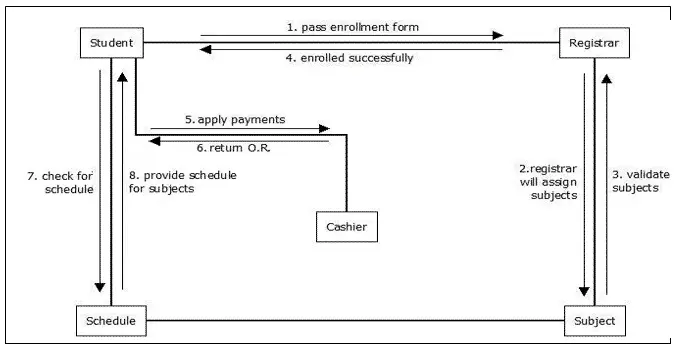
Figure 3: ICHS Existing System Activity Diagram shows the activities done to each object which is performed during the system process.
Data Flow Diagram of the Existing System
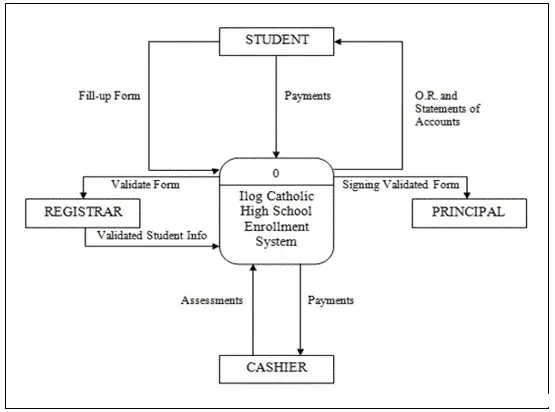
Figure 4: ICHS Existing System Data Flow Diagram shows the Data Flow Diagram of the manual process of enrollment system in Ilog Catholic High School.
First the student must fill up the form from the registrar and will be processed and validated to be returned to the student.
Then the student must proceed to the registrar to process the validation of form and the student’s information to be returned to the student.
After signing, the student must proceed to the cashier for processing of assessments and payments.
Then, the cashier will give the O.R. (Official Receipt) and student’s copy of assessments to the student.(Documentation for Computerized Enrollment System Chapter 4)
Related Capstone Resources
- Computerized Enrollment System Thesis Chapter 1
- Enrollment System Thesis Documentation Chapter 3
- Enrollment System Thesis Chapter 5 Proposed Solution
- Enrollment System Documentation Chapter 2
- 2019 Chapter 4 Existing System Library Borrowing System Doc
- Classroom Management System Thesis Documentation Chapter 4
Capstone chapter writing checklist
Structuring a BSIT capstone chapter correctly saves rework and eases the defense. Follow this checklist for consistent quality across all 5 chapters.
- Draft the outline first. Every section header first, then fill in the content.
- Write the methodology before the introduction. Chapter 3 (methodology) forces you to think through the system; Chapter 1 becomes easier after.
- Include diagrams early. UML diagrams in Chapter 3 clarify what you’re building.
- Cite sources as you write. Do not defer citations. Use Zotero or Mendeley to track sources.
- Get adviser feedback per chapter. Do not write all 5 chapters then ask for review.
- Number figures and tables. Figure 3.1, Table 4.2, etc. Panels reference these numbers.
- Follow the school template exactly. Font, margins, spacing — do not deviate.
Common capstone mistakes to avoid
- Copying without attribution. Panels use Turnitin. Cite everything you did not write yourself.
- Over-scoping the project. A well-executed simple system beats a poorly-executed ambitious one.
- Deferring documentation. Documentation quality is a big part of the grade.
- Skipping user testing. Panels ask about user feedback. Have real data.
- Ignoring adviser feedback. Advisers know what the panel will ask.
Recommended free tools for capstone projects
- draw.io / diagrams.net. UML diagrams for Chapter 3.
- Google Docs. Collaboration + version history + adviser comments.
- Zotero or Mendeley. Reference management + auto-formatted citations.
- GitHub. Version control for the source code (also earns E-E-A-T signal on your CV).
- Grammarly. Language + tone check on the documentation.
- Turnitin. Plagiarism check before submission (some schools provide access).
- ChatGPT or Claude. For outline scaffolding — not for writing the actual content.
Where to get more capstone resources
- Capstone project ideas. Browse itsourcecode.com/topics/fyp/ for 140+ tested capstone concepts.
- Working source code. itsourcecode.com/topics/free-projects/ has 1,000+ downloadable projects.
- UML diagrams. itsourcecode.com/uml/ has 300+ free UML examples for Chapter 3.
- ER diagrams. itsourcecode.com/topics/uml/erd/ for database schemas.
Official references
Frequently asked questions
How many pages should a BSIT capstone chapter be?
Chapter 1 (Introduction) is typically 8-12 pages. Chapter 2 (RRL) is 15-25 pages. Chapter 3 (Methodology and System Design) is 15-30 pages depending on diagram count. Chapter 4 (Results) is 10-20 pages. Chapter 5 (Conclusions) is 5-10 pages. Total: 60-100 pages for the whole capstone.
What order should I write the chapters in?
Recommended order: Chapter 3 first (system design and methodology — most concrete), then Chapter 1 (introduction with the problem statement), then Chapter 2 (RRL to justify Chapter 1), then Chapter 4 (results — after implementation), then Chapter 5 (conclusions). This avoids rewrites and speeds up defense readiness.
What formatting style should I use for the capstone documentation?
Most Philippine BSIT programs require IEEE or APA 7th edition. Confirm with your adviser first. Use Times New Roman 12pt, double-spaced, 1-inch margins, and page numbers. Reference all sources properly and use consistent citation style throughout.
How many references do I need per chapter?
Chapter 1: 5-10 references. Chapter 2 (RRL): 20-40 references. Chapter 3: 10-15 references. Chapter 4-5: minimal, mostly self-referential. Recent sources (last 5 years) are strongly preferred over older ones.
What tools help write the capstone chapters?
Zotero or Mendeley for reference management, Grammarly for language check, Turnitin for plagiarism scan, Google Docs for collaboration with adviser, LaTeX (Overleaf) for advanced formatting, and ChatGPT or Claude for outline scaffolding (not for writing the actual content).

Adrian Mercurio
Full-Stack Developer at PIES IT Solution
Specializes in building complete capstone projects with full documentation. Strong background in PHP/MySQL development and database design. Has personally built and tested over 30 capstone-ready projects with ER diagrams, DFDs, and chapter-by-chapter thesis documentation.
Expertise: PHP, Laravel, Database Design, Capstone Projects, C#, C, C++, Python, AI Projects · View all posts by Adrian Mercurio →