
Controlling Arduino Using Python PyFirmata
Pyfirmata is a Python package that lets you FULLY CONTROL the Arduino and code through Python.
In this article, I will show you how to control your Arduino without coding it!
What is Pyfirmata?
Pyfirmata is a Python package that lets you communicate your Python script to your Arduino.
This gives you access to all functions of the pins without coding the Arduino. Simply put, you can connect sensors without coding the board.
Using this, it is easier to integrate Arduino-based devices to other systems.
Arduino Setup
First thing to do is to setup the Arduino and upload “Standard Firmata” example code. To do this, open the Arduino IDE, go to File>Examples>Firmata>StandardFirmata. It will open a sample sketch.
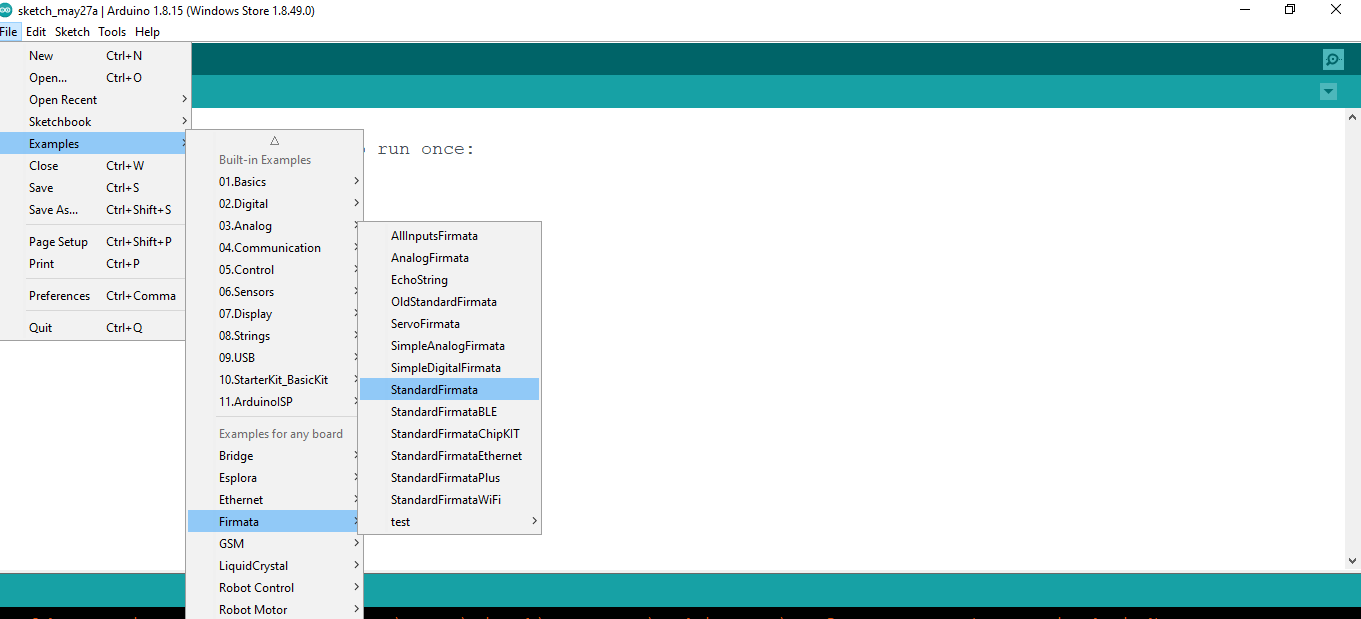
No need to edit anything from this sketch. Just connect your Arduino and upload the sketch.
PyFirmata Setup
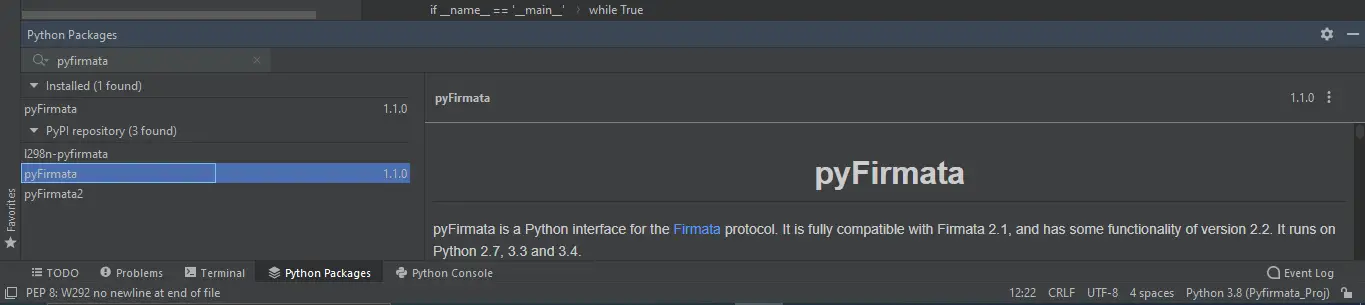
To install the package, simply search in the Python Packages window “PyFirmata”. just click install and wait for it to complete.
Sample Python Code
Now you can try the code below. The code below will make the Arduino blink its built-in LED. You can also read the pyfirmata documentation for more functions.
from pyfirmata import Arduino
import time

if __name__ == '__main__':
    board = Arduino('COM5')
    print("Communication Successfully started")

    while True:
        board.digital[13].write(1)
        time.sleep(1)
        board.digital[13].write(0)
        time.sleep(1)
Conclusion
So there you have it! Controlling Arduino Using Python PyFirmata.
This project is intimidating at first but you will see that it is fairly easy to do. You can combine this to other Python or Arduino projects and build an awesome system!
Click the button below to download the sample code.
Download
Technology stack and requirements
To run this Python project on your development machine, you need:
- Python 3.10 or higher. Download from python.org or install via Anaconda if you prefer bundled packages.
- pip package manager. Comes with Python. Used to install project dependencies from requirements.txt.
- Virtual environment. Use venv or conda to isolate project dependencies from your global Python install.
- VS Code or PyCharm. Free code editors with Python syntax highlighting, IntelliSense, and debugging.
- Git. For version control and cloning source code repositories.
Installing the source code
- Download or clone the repository. Get the ZIP archive from the download link on this page and extract it.
- Create a virtual environment. Open a terminal in the project folder and run: python -m venv venv, then activate it (venv\Scripts\activate on Windows or source venv/bin/activate on Mac/Linux).
- Install dependencies. Run pip install -r requirements.txt to install all libraries the project needs.
- Configure environment variables. If the project uses API keys (OpenAI, Anthropic, database), create a .env file and set the required keys.
- Run the project. Follow the run command in the README (usually python main.py or streamlit run app.py).
Using this project for your BSIT capstone
- Chapter 1 (Introduction). Discuss the real-world problem this system solves. Cite Philippine or international use cases where the manual process could be automated.
- Chapter 2 (RRL). Compare your project against 5-10 similar published works. Cite ACM, IEEE, or arXiv papers for academic-standard sources.
- Chapter 3 (Methodology). Document the model architecture, training data, hyperparameters, and evaluation metrics used.
- Chapter 4 (Results). Report accuracy, precision, recall, F1-score, and confusion matrix. Screenshot the running app on real inputs.
- Chapter 5 (Conclusion). Identify features for Version 2: better model, larger dataset, mobile deployment, or REST API.
Modules typical of Controlling Arduino Using Python PyFirmata
- Core Python logic. Main functions implementing the business logic of the system.
- Data storage. SQLite for simple projects, PostgreSQL or MongoDB for larger data.
- User interface. Tkinter for desktop, Streamlit for data dashboards, or Flask/FastAPI for web.
- Input validation. Type checking and range validation before processing user data.
- Reports. CSV or PDF export using pandas.to_csv() or ReportLab.
- Testing. pytest unit tests covering core functions.
Common enhancements for capstone review
- Add REST API. Convert desktop app to FastAPI service for mobile or web front-ends.
- Multi-user support. Add login, roles, and per-user data isolation.
- Cloud deployment. Deploy to Render, Railway, or Fly.io for public access.
- Docker containerization. Package the app in Docker for portable deployment.
Where to get help while building this Python project
- itsourcecode.com free downloads. Browse other Python projects for similar patterns and code examples.
- Python 3 official documentation. The canonical reference for language syntax and standard library.
- Stack Overflow Python tag. Fastest place to get unstuck on a specific error message.
- Kaggle notebooks. Real-world ML project examples with datasets and code you can adapt.
- HuggingFace model hub. Free pre-trained models for NLP, vision, and audio tasks.
- Your adviser. Regular check-ins keep the project on track.
Common defense pitfalls to avoid
- Empty dataset. Pre-populate 200-1000 realistic sample records so demos are meaningful and the model actually learns.
- Missing error handling. Wrap risky calls (file I/O, API calls, model loading) in try/except with user-friendly messages.
- Model overfitting. If validation accuracy is much lower than training accuracy, add regularization or more data.
- No deployment plan. Panel expects to see the app running, not just Jupyter notebooks. Deploy to Streamlit Cloud or HuggingFace Spaces.
- Untested edge cases. Test with empty input, malformed input, and very long input before demo day.
Official documentation
Frequently Asked Questions
How does this Python project work?
Built with Python 3.10+ and either Tkinter (desktop GUI), Django (web), or Flask (lightweight web). Standard structure: main.py launches the app, modules organized by feature, SQLite/MySQL for persistence.
What Python version and libraries does this project require?
Most projects in this batch use Python 3.10, 3.11, or 3.12 (avoid 3.13 until library wheels catch up). Standard libs: tkinter (built-in), sqlite3 (built-in). External: pip install pillow opencv-python pygame mysql-connector-python reportlab requests beautifulsoup4. Check the requirements.txt file (if included) for exact versions.
How do I set up the database for this Python project?
For SQLite (most common, no setup needed): the .db file auto-creates on first run. For MySQL: install MySQL Server + MySQL Workbench, create an empty database, import the included .sql file, edit the connection string in db.py (or db_connect.py) with your host, user, password, database name.
Can I use this Python project for a BSIT capstone or thesis?
Yes. Python is rising fast in Philippine BSIT panels. Extend it: add user roles via auth module, dashboards (matplotlib charts), PDF reports (reportlab), email notifications (smtplib), real domain extension (analytics, audit log, multi-branch support). Pair with Chapter 1-5 documentation matching your panel’s rubric.
Why am I getting ‘ModuleNotFoundError’ or ‘No module named X’?
Three common Python issues: (1) Module not installed: pip install
Where can I find more Python projects with source code?
Browse the Python Projects hub for the full library. For computer vision specifically see OpenCV Projects (46 vision systems). For ML / AI capstones see Machine Learning Projects. For BSIT capstone idea lists see 150 Best Capstone Project Ideas.
Related Articles
Inquiries
Feel free to write your questions about the Controlling Arduino Using Python PyFirmata at the comments below.