

A pivot table is a powerful feature in Excel that allows users to quickly analyze large quantities of data.
However, we can’t avoid the possibility that we might have to delete it from our worksheets.
Deleting a pivot table in Excel is simple. Just a few clicks, and then we’re good. But before we proceed to our tutorial, let’s first have a brief understanding of a pivot table.
What is a Pivot Table?
A pivot table is an essential Excel function that allows users to arrange and summarize complex data quickly.
This feature allows users to group their data by columns, sort it by values, and calculate statistics. In addition to that, pivot tables are very useful when you have a large quantity of data.
How to Delete a Pivot Table in Excel
Time needed: 1 minute
Here’s a simple guide on how to delete a pivot table easily:
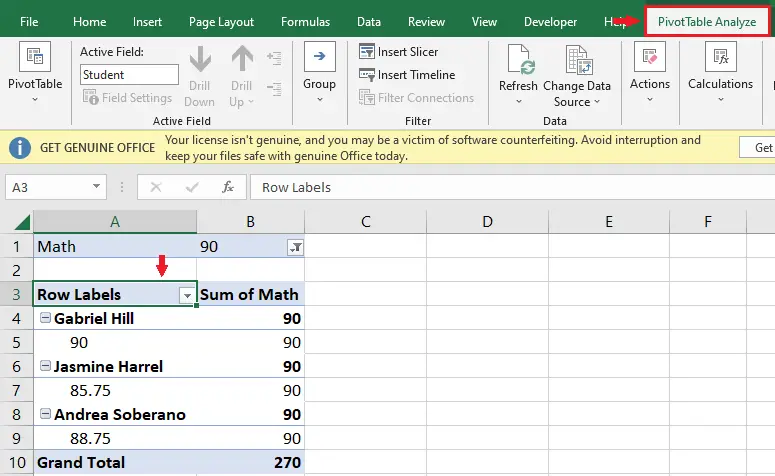
- Select the pivot table, then the PivotTable analyze tab.
The first thing to do is to click anywhere in the pivot table, then click the PivotTable analyze tab.
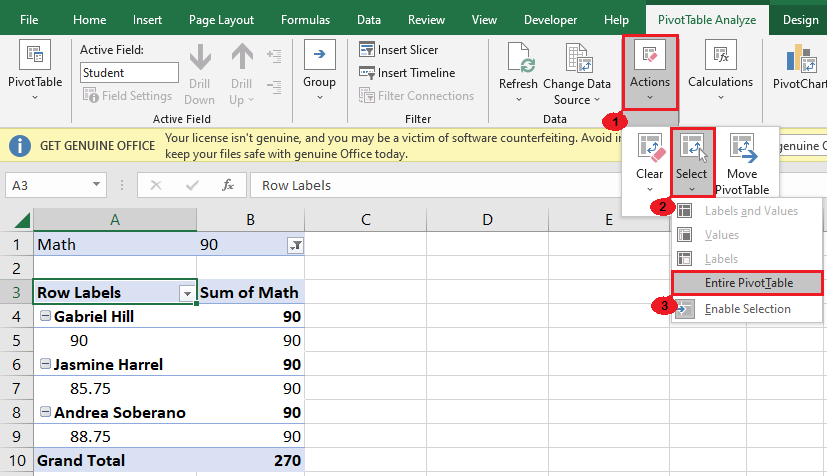
- Click Actions > Select, then Entire PivotTable.
Next, click the actions button > select, then select the entire pivot table.
- Click anywhere, then press delete.
Lastly, once the entire pivot table is selected, click anywhere on the sheet and press the delete key.
Note: The reason why you have to click anywhere is that if you don’t, the delete key alone won’t work.
Note: The easiest way to delete a pivot table is to press Ctrl + A, then delete keys, or directly delete the sheet. However, if your device doesn't have a keyboard or your keyboard doesn't work, kindly follow the steps above.Remove a Pivot Table in Excel but keep the data
Do you want to remove your pivot table but keep the data? Follow the steps below to achieve exactly what you want.
Here’s a step-by-step guide on how to remove a pivot table in Excel but keep the data:
Step 1: Click anywhere in the pivot table.
Step 2: Click the PivotTable analyze tab in the ribbon.
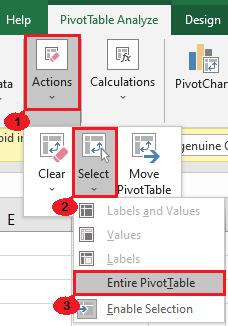
Step 3: Click the actions button > select, then choose the Entire PivotTable.
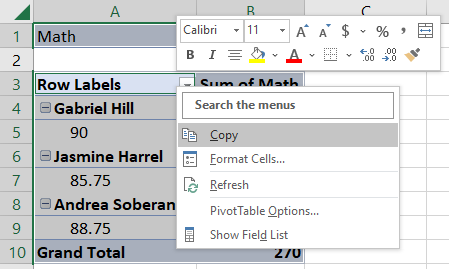
Step 4: Right-click in any cell of the selected table, then pick copy.
Step 5: Click the Home tab > Paste option, then choose Paste Values (V).
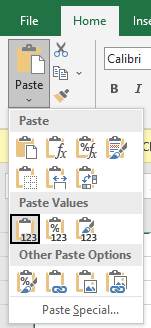
Note: The steps above would delete the pivot table but keep the data. However, if a message box appears (see image below) after the last step is applied, do this alternative step:
 Upon clicking copy, select a cell where you want to place the data, and that's when you do the fifth step.
 Upon clicking copy, select a cell where you want to place the data, and that's when you do the fifth step.
You can also use these keyboard shortcuts:
- Click Ctrl + A keys to select all.
- To copy the selected data, click Ctrl + C keys.
- To paste, click Alt + E + S + V, then click OK.
Clear the data, but keep the pivot table
In this example, we’re going to clear the data in the pivot table but keep the pivot table. How do we do that? Here are the simple steps:
❶ Click anywhere in the pivot table.
❷ Click the PivotTable analyze tab in the ribbon.
❸ Click the actions button > clear, then select clear all.
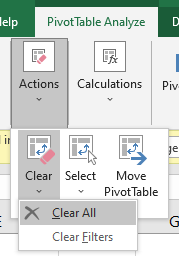
Note: If a message box appears (see image below) after clicking Clear All, kindly click the OK button.

Conclusion
In conclusion, deleting a pivot table in Excel is an easy thing to do. You just follow the simple steps in this tutorial, and you’re good.
I think we’re done with this article. I hope you’ve learned something from this. Do not forget to share this with your friends.
Thank you for reading! If you have any questions or suggestions, please leave a comment below.
What is new when deleting PivotTables in 2026
Excel 365 in 2026 shows a small confirmation prompt when you delete a PivotTable that has an active Slicer or Timeline connected to it. The prompt warns that the Slicer will become disconnected but stay on the sheet. Click OK to delete, then remove the orphan Slicer manually with a right-click.
The Copilot pane also now offers a Clean up unused PivotCaches action for workbooks with 5 or more PivotTables. Open Copilot, type Remove unused PivotCaches, and Copilot lists caches with no active PivotTable pointing at them, then deletes them on confirmation. Workbook file size can drop by 30 to 60 percent on report-heavy files.
Common deletion pitfalls
- Deleting cells instead of the PivotTable. Selecting the PivotTable body cells and pressing Delete only clears values, not the PivotTable structure. Use PivotTable Analyze > Select > Entire PivotTable first.
- Downstream formulas break. Any GETPIVOTDATA formula pointing at the deleted table returns #REF. Search the workbook for GETPIVOTDATA before deleting and either remove the formulas or rebuild against a different PivotTable.
- Cache stays behind. Deleting a PivotTable does not automatically delete its PivotCache. If disk space matters, close and reopen the file (Excel prompts to compact) or use the Copilot Clean up action above.
- Undo does not always work. Ctrl Z can bring back the PivotTable structure but not the Slicers or Timelines. Save the workbook before large deletion operations as insurance.
Deleting multiple PivotTables at once
To delete every PivotTable on a single sheet, hold Ctrl and click each PivotTable in turn to select all, then press Delete. To delete every PivotTable in the workbook, use VBA:
Sub DeleteAllPivotTables()
    Dim ws As Worksheet, pt As PivotTable
    For Each ws In ThisWorkbook.Worksheets
        For Each pt In ws.PivotTables
            pt.TableRange2.Clear
        Next pt
    Next ws
End Sub
Save as .xlsm to run. Consider making a backup copy of the file first.
Official documentation
Quick step-by-step summary (click to expand)
- Click anywhere in the PivotTable Click any cell inside the PivotTable to activate the PivotTable Analyze tab on the ribbon.
- Select the entire PivotTable Click PivotTable Analyze > Actions > Select > Entire PivotTable to select the full report.
- Press Delete Press the Delete key on your keyboard to remove the entire PivotTable from the sheet.
- Clear the PivotTable cache (optional) Right-click any remaining PivotTable in the workbook, choose PivotTable Options, and tick Save source data with file to force a cache rebuild on next refresh.
- Save the workbook Press Ctrl S to save. The file size shrinks noticeably when unused caches are cleared.
Frequently Asked Questions
What happens to my source data when I delete a PivotTable?
The source data is not touched. Only the PivotTable summary report is removed. The original data range or Excel Table stays exactly as it was.
Can I recover a deleted PivotTable?
Yes, press Ctrl Z immediately after deletion to undo. If you have saved and closed the file, restoration is not possible without a backup.
Why does the PivotTable reappear after I delete it?
You likely deleted only the values, not the PivotTable structure. Use PivotTable Analyze > Select > Entire PivotTable, then press Delete.
Does deleting a PivotTable delete its Slicer?
No. Slicers and Timelines connected to a deleted PivotTable stay on the sheet as orphan controls. Right-click each and choose Remove.
How do I delete a PivotTable in Excel for the web?
Click inside the PivotTable, go to PivotTable Analyze > Actions > Select > Entire PivotTable, then press Delete. Same steps as desktop.
Can Copilot delete a PivotTable for me?
Yes. Open the Copilot pane and type Delete this PivotTable. Copilot removes the table and prompts you before removing connected Slicers.

Elijah Galero
Programmer & Technical Writer at PIES IT Solution
Elijah Galero is a programmer and writer at PIES IT Solution, author of 175+ tutorials at itsourcecode.com. Specializes in Python error debugging (AttributeError, TypeError, ModuleNotFoundError), Python programming tutorials, and Microsoft Excel how-to guides for BSIT students and productivity learners.
Expertise: Python · Python Errors · Python AttributeError · Python TypeError · ModuleNotFoundError · MS Excel · MS PowerPoint · View all posts by Elijah Galero →