

In this article, we will discuss solutions in attributeerror: module ‘collections’ has no attribute ‘mutablemapping’.
We will also look at the causes, and briefly discuss this error.
Let’s get started!
What is module ‘collections’ has no attribute ‘mutablemapping’?
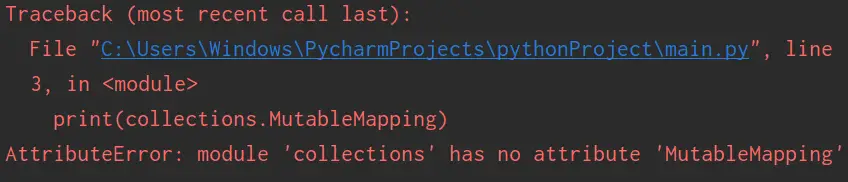
The AttributeError: module ‘collections’ has no attribute ‘MutableMapping’ error in python appears when MutableMapping class when is used in Python version 3.10.
Wherein apparently it has been moved from the collections module to collections.abc module.
These are a few reasons why this error happens:
- Importing the MutableMapping class from the collections module in Python versions 3.10+.
- When installing a module that imports the MutableMapping class from the collections module using Python versions 3.10+.
Since we’re using python 3.10+ here’s how this error occurs:
import collections

print(collections.MutableMapping)
Output:
Solutions to fix Attributeerror: module ‘collections’ has no attribute ‘mutablemapping’
Here are the solutions you can try to fix the error Attributeerror: module ‘collections’ has no attribute ‘mutablemapping’. Choose what works for you.
- Upgrade Python packages to the latest versions
If you see this error when running pip commands, then you can try to upgrade the built-in Python packages and see if it fixes the error.
Run one of the following commands from the terminal:
pip install –upgrade pip wheel setuptools requests

For pip3:
pip3 install –upgrade pip wheel setuptools requests
If pip is not in PATH:
python -m pip install –upgrade pip wheel setuptools requests
python3:
python3 -m pip install –upgrade pip wheel setuptools requests
Note: Outdated version of this package will trigger the error. - Downgrade Python version to 3.9 or lower
Downgrading python version to 3.9 or lower is another way since the error is specific to python 3.10 version.
Apparently, all we need is to install the lower version successfully.
It will replace the older python version. It means you do not have to explicitly uninstall the current python version.
- Change the import statement
Actually, since the internal structure is changed in the 3.10 version so have to use two different ways for importing this mutablemapping module. Here is the syntax difference-
For version 3.9 or lower –
from collections import MutableMapping
For version 3.10 or above –
from collections.abc import MutableMapping - Import statement to work for all Python versions
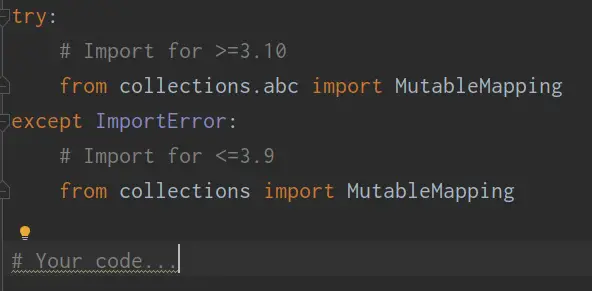
This time if we would like to use import statement that will work in all python version, then we will use the import statement with try and except block.
See how it works:

The try statement in the code above will attempt to import from collections.abc module. Hence, the import causes an error the except block will attempt to import from the collections module rather.

Conclusion
In conclusion to fix the Attributeerror: module ‘collections’ has no attribute ‘mutablemapping’ error, we should try the following:
- Import the MutableMapping class from collections.abc, as a modification was made in Python 3.10.
- Update module versions having an old import statement.
- Alternatively, downgrade to Python 3.9 if you are incapable to make corrections.
We hope that this article has provided you with the information you need to fix this error and continue working with Python.
If you are finding solutions to some errors you’re encountering we also have Attributeerror: module ‘numpy’ has no attribute ‘bool’.
Python AttributeError debugging checklist
- Print the actual type. Insert
print(type(obj))before the failing line — usually reveals the mismatch immediately. - Use dir().
print(dir(obj))lists all available attributes on the object. - Check version compatibility. Many AttributeErrors come from methods that were renamed or removed between library versions.
- Guard with hasattr().
if hasattr(obj, "method"): obj.method()— useful for cross-version code. - Use type hints + mypy. Static type checking catches most AttributeErrors before you run the code.
Common root causes across all AttributeError variants
- None return values. A function returned None when the caller expected an object.
- Version drift. Library API changed between versions.
- Variable overwrite. A local variable was reassigned with the wrong type (list → dict, str → int).
- Method vs attribute confusion. Calling a property with () or accessing a method without ().
- Missing initialization. Some frameworks require
init()before accessing certain attributes.
Modern Python tooling to prevent AttributeError
- Type hints + Optional[T]. Explicit null-handling in signatures.
- mypy or Pyright. Runs your codebase through a type checker before you run it.
- Ruff. Fast linter that catches many attribute-access issues.
- pydantic v2. Runtime validation with the same syntax as static types.
- pytest fixtures. Test with edge-case inputs to catch AttributeError paths early.
Official documentation
Frequently Asked Questions
What is Python AttributeError and what causes it?
AttributeError is raised when you access an attribute or method that doesn’t exist on the object. Most common cause: calling a method on None (NoneType has no attribute X). Other causes: typo in method name, wrong object type (str when you expected list), or using a feature removed in a newer library version. The error names exactly which type and which missing attribute.
How do I fix ‘NoneType object has no attribute’?
The variable you’re accessing is None, but you expected an object. Trace back to where it was assigned: a function returning None instead of an object (forgot to return), a database query returning no rows (Model.objects.first() returns None when empty), or an API call that failed silently. Safe pattern: if obj is not None: obj.method() OR use the walrus operator: if (obj := get_obj()): obj.method().
How do I check if an attribute exists before accessing it?
Use hasattr(obj, ‘attr_name’) for runtime check, or getattr(obj, ‘attr_name’, default) to get-with-default. For frequent attribute checks, consider type hints + mypy/pyright which catch most AttributeErrors at static-analysis time before runtime.
How do I prevent AttributeError from None values?
Three patterns: (1) Always validate function returns (if result is None: raise). (2) Use type hints with Optional[X] to make None-ability explicit. (3) Use the walrus operator + early return: if (val := get_val()) is None: return default; use val. Defensive coding around None-able returns prevents 90% of AttributeError in production.
Where can I find more AttributeError fixes?
Browse the AttributeError reference hub for 170+ specific fixes (NoneType, pandas, NumPy, sklearn, Selenium). For related errors see TypeError. For Python debugging fundamentals see Python Tutorial hub.

Glay Eliver
Programmer & Technical Writer at PIES IT Solution
Glay Eliver is a programmer and writer at PIES IT Solution, author of over 600 tutorials at itsourcecode.com. Specializes in JavaScript tutorials, Microsoft Office how-tos (Excel, Word, PowerPoint), and Python error debugging covering ImportError, TypeError, AttributeError, ModuleNotFoundError, and JavaScript ReferenceError. Authored several of the site’s highest-traffic Excel and MS Office reference articles.
Expertise: JavaScript · MS Excel · MS Word · MS PowerPoint · Python · Python ImportError · Python TypeError · Python AttributeError · ModuleNotFoundError · JavaScript ReferenceError · Pygame
· View all posts by Glay Eliver →