

In this article, we will show you how to solve the Python error attributeerror: numpy.ndarray object has no attribute plot. Aside from that, we’ll also give you a brief definition of Python.
We understand how frustrating it is to encounter errors when working on a project. Hence, you do not have to worry, as we’re here to help you.
Back to the topic: why do you think this error occurs? What is the possible reason for this error to appear? To answer our whats and whys, here’s some enlightenment.
Why does this error occur?

This error occurs when we try to call the plot() method on a NumPy array object and that object does not have a plot() method.

It just means that the possible reason this error appears is that we are using the plot() function on an unalike object.

What is Python?

Python is one of the most popular programming languages. It is used for developing a wide range of applications. It is a high-level programming language that is usually used by developers nowadays due to its flexibility.
Now that we already know about this error, we must take a few actions to fix it. So without further ado, let’s move on to our “how to fix this error” tutorial.
How to solve “numpy.ndarray object has no attribute plot” in Python
Resolving the error attributeerror: numpy.ndarray object has no attribute plot is an easy task. All you have to do is convert the NumPy array to a pandas DataFrame. In doing this, we’ll be able to use the plot() method.
Here’s the step-by-step guide on how to convert the NumPy array to a pandas DataFrame and use the plot() method.
- Create a NumPy array.
The first step is to create a NumPy array. For example:
numpy_array = np.array([10, 30, 50, 70, 90])Note: You can change the variable “numpy_array” to a variable that you want.
- Convert the NumPy array to a Pandas DataFrame.
The next step is to convert the NumPy array to a Pandas DataFrame. For example:
dframe = pd.DataFrame(numpy_array)Note: You can change the variable “dframe” to a variable that you want.
- Use the plot() method.
Lastly, you can now use the plot() method on the DataFrame. By doing so, use the command:
dframe.plot() - Example.
import numpy as np
import pandas as pd
numpy_array = np.array([10, 30, 50, 70, 90])
dframe = pd.DataFrame(numpy_array)
dframe.plot()Note: Use the show() function to display the figure (see sample below).
Show() function
The show() function is used to display figures. Here’s an example using it:
import numpy as np
import pandas as pd
from matplotlib import pyplot as plt
numpy_array = np.array([10, 30, 50, 70, 90])
dframe = pd.DataFrame(numpy_array)
dframe.plot()
plt.show()Result:
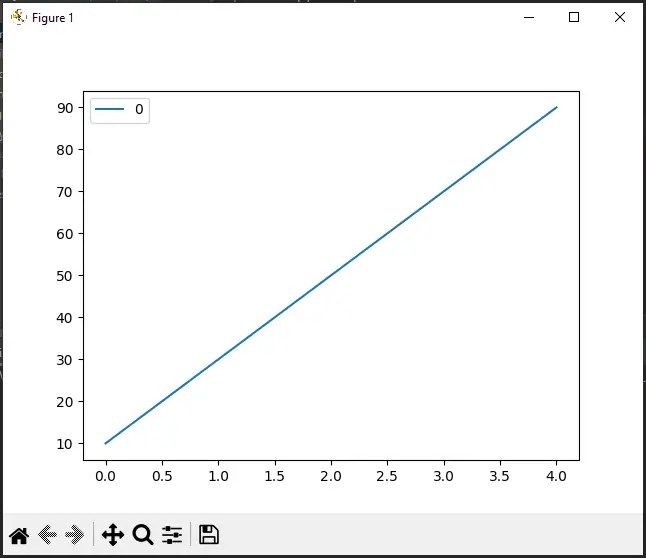
Note: For the plt.show() function to work, you have to import matplotlib.pyplot as plt.
NumPy AttributeError patterns
NumPy AttributeErrors usually come from mixing Python lists with ndarrays, using removed aliases (np.int, np.float were dropped in 1.20+), or confusing scalar vs array methods.
Common triggers
- Deprecated type aliases.
np.int,np.float,np.boolwere removed in NumPy 1.20. Use built-inint,float,boolinstead. - Python list vs ndarray. A Python list has no
.shape,.reshape, or.dtype. Wrap withnp.array()first. - Scalar vs array methods. Some numpy methods return a scalar (int, float) that lacks array methods like
.reshape. - Attribute-vs-function confusion.
arr.maxis a method;arr.max()ornp.max(arr)is a value.
Diagnostic pattern
# BAD — np.int removed
sizes = np.array([1, 2, 3], dtype=np.int)  # AttributeError: module 'numpy' has no attribute 'int'

# GOOD — use built-in int or np.int64
sizes = np.array([1, 2, 3], dtype=int)      # ok
sizes = np.array([1, 2, 3], dtype=np.int64) # explicit width

# BAD — Python list has no .shape
raw = [[1, 2], [3, 4]]
raw.shape  # AttributeError: 'list' object has no attribute 'shape'

# GOOD — convert first
arr = np.array(raw)
print(arr.shape)  # (2, 2)
Best practices
- Check numpy version. Many API changes between 1.x and 2.x.
- Always convert with np.array() when moving from Python data structures.
- Use dtype explicitly.
np.int64,np.float32— no ambiguity. - Use type hints with numpy.typing. NDArray[np.int64] communicates shape expectations.
Official documentation
Frequently Asked Questions
What is Python AttributeError and what causes it?
AttributeError is raised when you access an attribute or method that doesn’t exist on the object. Most common cause: calling a method on None (NoneType has no attribute X). Other causes: typo in method name, wrong object type (str when you expected list), or using a feature removed in a newer library version. The error names exactly which type and which missing attribute.
How do I fix ‘NoneType object has no attribute’?
The variable you’re accessing is None, but you expected an object. Trace back to where it was assigned: a function returning None instead of an object (forgot to return), a database query returning no rows (Model.objects.first() returns None when empty), or an API call that failed silently. Safe pattern: if obj is not None: obj.method() OR use the walrus operator: if (obj := get_obj()): obj.method().
How do I check if an attribute exists before accessing it?
Use hasattr(obj, ‘attr_name’) for runtime check, or getattr(obj, ‘attr_name’, default) to get-with-default. For frequent attribute checks, consider type hints + mypy/pyright which catch most AttributeErrors at static-analysis time before runtime.
How do I prevent AttributeError from None values?
Three patterns: (1) Always validate function returns (if result is None: raise). (2) Use type hints with Optional[X] to make None-ability explicit. (3) Use the walrus operator + early return: if (val := get_val()) is None: return default; use val. Defensive coding around None-able returns prevents 90% of AttributeError in production.
Where can I find more AttributeError fixes?
Browse the AttributeError reference hub for 170+ specific fixes (NoneType, pandas, NumPy, sklearn, Selenium). For related errors see TypeError. For Python debugging fundamentals see Python Tutorial hub.
Conclusion
In conclusion, the error attributeerror: numpy.ndarray object has no attribute plot can be easily solved by converting the NumPy array to a pandas DataFrame before using the plot() method.
By following the guide above, there’s no doubt that you’ll be able to resolve this error quickly.
We hope you’ve learned a lot from this. If you have any questions or suggestions, please leave a comment below, and for more Python tutorials, visit our website.
Thank you for reading!

Elijah Galero
Programmer & Technical Writer at PIES IT Solution
Elijah Galero is a programmer and writer at PIES IT Solution, author of 175+ tutorials at itsourcecode.com. Specializes in Python error debugging (AttributeError, TypeError, ModuleNotFoundError), Python programming tutorials, and Microsoft Excel how-to guides for BSIT students and productivity learners.
Expertise: Python · Python Errors · Python AttributeError · Python TypeError · ModuleNotFoundError · MS Excel · MS PowerPoint
· View all posts by Elijah Galero →