

In this tutorial, we will discuss the best way to resolve the attributeerror: module torch._c has no attribute cuda_setdevice.
What is _cuda_setdevice?
The _cuda_setdevice is a function in the PyTorch library which is used to set the current CUDA device.
If you are running PyTorch code on a computer with multiple GPUs.
This function can be used to select which GPU to use for computation.
Also, read or visit the other resolved attributeerror:
- Attributeerror: module ‘cv2’ has no attribute ‘_registermattype’
- attributeerror numpy ndarray object has no attribute iloc [Solved]
Why the attributeerror: module torch._c has no attribute _cuda_setdevice occur?
The AttributeError “module ‘torch._C’ has no attribute ‘_cuda_setdevice’” typically occurs because there is an incompatibility between the version of the PyTorch library you are using and the version of CUDA on your system.
How to solved the attributeerror: module ‘torch._c’ has no attribute ‘_cuda_setdevice’?
Time needed: 3 minutes
Here are some steps you can take to solve this error attributeerror: module ‘torch._c’ has no attribute ‘cuda_setdevice’:
- Step 1: Check your PyTorch and CUDA versions
First, you can check the version of PyTorch and CUDA through executing the following commands in your Python interpreter:
import torch
print(torch.version)
print(torch.version.cuda)Make sure that the PyTorch version is compatible with the CUDA version on your system. You can find a list of compatible versions in the PyTorch documentation.
- Step 2: Update your PyTorch installation
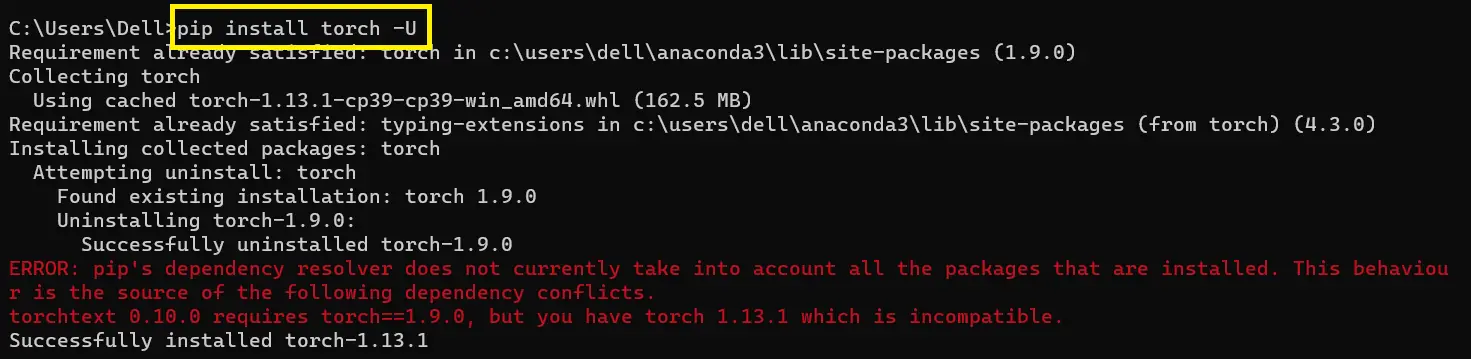
Next, when your PyTorch version is ou-of-date, you can update it using pip command:
pip install torch -U
After you run the command above it will upgrade PyTorch to the latest version available on PyPI.

- Step 3: Check your CUDA installation
Next, When your PyTorch version is compatible with your CUDA version, make sure that CUDA is installed correctly on your system.
You can check the installation through executing the following command:
nvcc –version
If you run the above code it will print the version of CUDA installed on your system. If you get an error, it will show that CUDA is not installed correctly.
- Step 4: Reinstall PyTorch with the correct CUDA version
Next, When you have checked both your PyTorch and CUDA installations and they are correct, try reinstalling PyTorch with the correct CUDA version.
You can define the CUDA version to use during installation using the
torchcommand:pip install torch==1.8.1+cu111 -https://download.pytorch.org/whl/cu111/torch_stable.html
The above command will install PyTorch version 1.8.1 with CUDA version 11.1.
- Step 5: Reinstall PyTorch
Finally, If the above steps did not solve the issue, you can try to uninstall PyTorch and then reinstall it again with the correct installation. You can use the following command:
To uninstall:
pip uninstall torch
To install:
pip install torch
PyTorch AttributeError patterns
PyTorch AttributeErrors usually come from confusing Tensor and numpy arrays, device mismatches (CPU vs CUDA), or module vs functional API mixups.
Common triggers
- Tensor vs ndarray. Some methods exist on numpy but not torch tensors and vice versa.
tensor.reshapeworks;tensor.resizedoes not (use.view). - Requires grad on leaf tensors. Non-leaf tensors do not support in-place modification of
.data. - nn.Module vs torch.nn.functional. Some ops live in one module only.
- Model saved from different PyTorch version. Loading old checkpoints may fail if internal attribute names changed.
Diagnostic pattern
# BAD — mixing numpy and torch
import torch, numpy as np
arr = np.array([1, 2, 3])
arr.cuda()  # AttributeError: 'numpy.ndarray' object has no attribute 'cuda'

# GOOD — convert first
tensor = torch.from_numpy(arr).cuda()

# BAD — attribute vs method
tensor.shape()  # TypeError, but often precedes AttributeError trees
# tensor.shape is an attribute, not a method
print(tensor.shape)  # ok — torch.Size([3])
Best practices
- Convert at boundaries.
torch.from_numpy(arr)andtensor.numpy(). - Track devices explicitly. Use
.to(device)to move between CPU and CUDA. - Pin torch version. CUDA compatibility matters — check
torch.__version__. - Use torch.jit or ONNX for production — freezes the API.
Official documentation
Frequently Asked Questions
What is Python AttributeError and what causes it?
AttributeError is raised when you access an attribute or method that doesn’t exist on the object. Most common cause: calling a method on None (NoneType has no attribute X). Other causes: typo in method name, wrong object type (str when you expected list), or using a feature removed in a newer library version. The error names exactly which type and which missing attribute.
How do I fix ‘NoneType object has no attribute’?
The variable you’re accessing is None, but you expected an object. Trace back to where it was assigned: a function returning None instead of an object (forgot to return), a database query returning no rows (Model.objects.first() returns None when empty), or an API call that failed silently. Safe pattern: if obj is not None: obj.method() OR use the walrus operator: if (obj := get_obj()): obj.method().
How do I check if an attribute exists before accessing it?
Use hasattr(obj, ‘attr_name’) for runtime check, or getattr(obj, ‘attr_name’, default) to get-with-default. For frequent attribute checks, consider type hints + mypy/pyright which catch most AttributeErrors at static-analysis time before runtime.
How do I prevent AttributeError from None values?
Three patterns: (1) Always validate function returns (if result is None: raise). (2) Use type hints with Optional[X] to make None-ability explicit. (3) Use the walrus operator + early return: if (val := get_val()) is None: return default; use val. Defensive coding around None-able returns prevents 90% of AttributeError in production.
Where can I find more AttributeError fixes?
Browse the AttributeError reference hub for 170+ specific fixes (NoneType, pandas, NumPy, sklearn, Selenium). For related errors see TypeError. For Python debugging fundamentals see Python Tutorial hub.
Conclusion
To conclude, through following the steps above, you should be able to solve the AttributeError “module ‘torch._C’ has no attribute ‘_cuda_setdevice’” and it will successfully use PyTorch with CUDA on your system.

Adones Evangelista
Programmer & Technical Writer at PIES IT Solution
Adones Evangelista is a programmer and writer at PIES IT Solution, author of over 900 tutorials and error-fix guides at itsourcecode.com. Specializes in JavaScript, Django, Laravel, and Python error debugging covering ValueError, TypeError, AttributeError, ModuleNotFoundError, and RuntimeError, plus C/C++ and PHP capstone projects for BSIT students.
Expertise: JavaScript · Python · Django · Laravel · Error Debugging · C/C++
· View all posts by Adones Evangelista →