
The “attributeerror: module pandas has no attribute read_csv” is an error message when you’re working with the Pandas library in Python.
If you were struggling to fix this error, stop worrying by this time.
It is because in this article we are going to show you the solutions to this error.
Apart from that, we’ll explain in detail why this error “module pandas has no attribute read_csv” occurs, different solutions, and tips to avoid it in the future.
What is “attributeerror: module pandas has no attribute read_csv” error message?
This “attributeerror: module ‘pandas’ has no attribute ‘read_csv’,” error message indicates that Pandas is unable to find the “read_csv” function within the Pandas module.
That is used to read CSV files into a Pandas DataFrame.
Why does this error occur?
This error can occur due to various reasons, such as:
- Outdated Pandas version
- Incorrect installation
- Typos in the code
How to fix “attributeerror: module pandas has no attribute read_csv”
Now that you fully understand this “module ‘pandas’ has no attribute ‘read_csv’,“ error message.
Let’s jump into the solutions that you may use to troubleshoot the error that you are currently facing.
Solution 1: Check your Pandas version
import pandas as pd

print(pd.__version__)
If the version displayed is older than the latest version available, you can update Pandas by running the following command in your terminal:
pip install -U pandas
or
pip install –upgrade pandas
Solution 2: Check your installation
You can simply check your installation by running the following code:
import pandas as pd
print(pd.__file__)
Output:
C:\Users\pies-pc2\PycharmProjects\pythonProject\venv\Lib\site-packages\pandas\__init__.pySolution 3: Check your file path
Usually this error could happen when you did not put the exact location of the data, even though you wrote the correct file name.
For example:
df = pd.read_csv('venv\data.csv')Solution 4: Check your code for typos
You code should look like this:
import pandas as pd

df = pd.read_csv('data.csv')
print(df.head())
Double-check that you are using the correct syntax and function names, and that you have imported the Pandas module correctly.
Solution 4: Use the from pandas import method
Example:
from pandas import read_csv

df = read_csv('data.csv')
print(df.head())
Output:
  Sample1  sample2  sample3
0        1        2       9
1        2        4       6
2        3        6       9
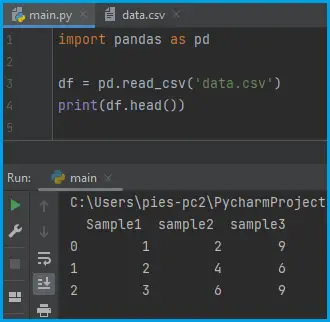
Here’s what the actual code and output look like:
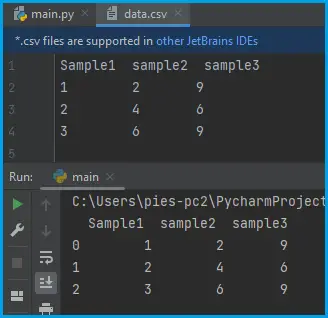
Here’s a sample data.csv and the result:
Solution 5: Reinstall Pandas
When the above solutions do not work, you can try reinstalling Pandas entirely.
You can do this by uninstalling Pandas first and then reinstalling it using the pip package manager.
To uninstall:
pip uninstall pandas
To reinstall:
pip install pandas
Tips to avoid similar errors in the future
The “attributeerror: module pandas has no attribute read_csv” error can be frustrating, but there are some steps you can take to avoid similar errors in the future:
- Ensure that you’re using the latest version of Pandas to avoid any potential issues with outdated functions.
- Always double-check your code for typos and spelling mistakes.
- You can use an Integrated Development Environment (IDE) like PyCharm or Spyder that can help you catch errors in your code.
Frequently Asked Questions (FAQs)
Definitely, yes. Pandas can read and write data in several different file formats, including Excel, JSON, and SQL databases.
Yes, you can read CSV files using Python’s built-in CSV module.
However, Pandas is a more user-friendly and powerful interface for data analysis.
If you’re still encountering the error message after trying the above solutions, there might be a deeper problem with your code or environment.
You can try to restart your Python environment.
Related Articles for Python Errors
- Attributeerror: list object has no attribute items
- Attributeerror: ‘series’ object has no attribute ‘split’
- Attributeerror: ‘tfidfvectorizer’ object has no attribute ‘get_feature_names’
Conclusion
By executing the different solutions that this article has given, you can easily fix the “attributeerror: module pandas has no attribute read_csv” error message when working in Python.
We are hoping that this article provides you with sufficient solutions; if yes, we would love to hear some thoughts from you.
Thank you very much for reading to the end of this article.
Just in case you have more questions or inquiries, feel free to comment, and you can also visit our website for additional information.
Pandas AttributeError patterns
Pandas AttributeErrors usually fall into 4 categories: deprecated methods removed in newer versions, wrong object type (DataFrame vs Series), typos in column/method names, or attribute-vs-method confusion (e.g. df.shape vs df.shape()).
Common triggers
- Deprecated method removed. pandas 2.0+ removed several long-deprecated methods (
.ix,.append()). Use.loc,pd.concat()instead. - Series vs DataFrame method. Some methods exist on one but not the other.
DataFrame.iterrows()works, butSeries.iterrows()does not. - Case-sensitive column names. Accessing
df.Namewhen column is “name” fails. - Attribute-style access dropped for non-identifier columns.
df.my-columnfails; usedf["my-column"]. - Reading empty CSV.
pd.read_csv(f).columnsmay fail if the file was empty.
Diagnostic pattern
# BAD — pandas 2.0+ dropped DataFrame.append
df1 = pd.DataFrame({"x": [1, 2]})
df2 = pd.DataFrame({"x": [3, 4]})
combined = df1.append(df2)  # AttributeError: 'DataFrame' object has no attribute 'append'

# GOOD — use pd.concat
combined = pd.concat([df1, df2], ignore_index=True)

# BAD — .ix removed in pandas 1.0+
row = df.ix[0]  # AttributeError

# GOOD — use .loc for label, .iloc for position
row_by_label = df.loc[0]
row_by_pos = df.iloc[0]
Best practices
- Check pandas version.
pd.__version__— many API changes between 1.x and 2.x. - Use bracket notation for columns.
df["col"]works for any column name, unlike dot notation. - Migrate to polars for new projects. Modern Rust-based DataFrames — often 10x faster and cleaner API.
- Pin pandas version in requirements.txt to avoid silent API breaks.
Official documentation
Frequently Asked Questions
What is Python AttributeError and what causes it?
AttributeError is raised when you access an attribute or method that doesn’t exist on the object. Most common cause: calling a method on None (NoneType has no attribute X). Other causes: typo in method name, wrong object type (str when you expected list), or using a feature removed in a newer library version. The error names exactly which type and which missing attribute.
How do I fix ‘NoneType object has no attribute’?
The variable you’re accessing is None, but you expected an object. Trace back to where it was assigned: a function returning None instead of an object (forgot to return), a database query returning no rows (Model.objects.first() returns None when empty), or an API call that failed silently. Safe pattern: if obj is not None: obj.method() OR use the walrus operator: if (obj := get_obj()): obj.method().
How do I check if an attribute exists before accessing it?
Use hasattr(obj, ‘attr_name’) for runtime check, or getattr(obj, ‘attr_name’, default) to get-with-default. For frequent attribute checks, consider type hints + mypy/pyright which catch most AttributeErrors at static-analysis time before runtime.
How do I prevent AttributeError from None values?
Three patterns: (1) Always validate function returns (if result is None: raise). (2) Use type hints with Optional[X] to make None-ability explicit. (3) Use the walrus operator + early return: if (val := get_val()) is None: return default; use val. Defensive coding around None-able returns prevents 90% of AttributeError in production.
Where can I find more AttributeError fixes?
Browse the AttributeError reference hub for 170+ specific fixes (NoneType, pandas, NumPy, sklearn, Selenium). For related errors see TypeError. For Python debugging fundamentals see Python Tutorial hub.

Caren Bautista
Technical Writer at PIES IT Solution
Responsible for crafting clear, well-structured, and beginner-friendly content across the platform. Handles the writing, proofreading, and editorial review of tutorials, guides, and documentation to ensure every article is accurate, readable, and easy to follow.
Expertise: Technical Writing · Content Creation · Documentation · Editorial Writing · JavaScript · TypeScript · Python · Python Errors · HTTP Errors · MS Excel
· View all posts by Caren Bautista →