
In this article, we will explain what this error Attributeerror: module ‘numpy’ has no attribute ‘typeddict’ means and how to fix it.
But before jumping solutions, we will understand this Attributeerror: module ‘numpy’ has no attribute ‘typeddict’ first.
What is NumPy?
NumPy (Numerical Python) is a popular library for scientific computing in Python. It provides support for large, multi-dimensional arrays and matrices.
Along with a collection of high-level mathematical functions to operate on these arrays.
Additionally, NumPy is an essential library for data science, as it provides efficient operations on arrays and matrices. Making it ideal for scientific computing and data analysis.
What is TypedDict?
TypedDict is a feature introduced in Python 3.8 for defining dictionaries with specific key-value types.
Moreover, it allows you to specify the type of each key-value pair in a dictionary, making it easier to validate and manipulate dictionary data.
What is the Attributeerror: module ‘numpy’ has no attribute ‘typeddict’
The AttributeError: module ‘numpy’ has no attribute ‘TypedDict‘ error means that NumPy does not have the TypedDict attribute or method.
In other words, NumPy does not support the TypedDict feature.
Causes of the Module ‘NumPy’ Has No Attribute ‘TypedDict’
The primary cause of the AttributeError: module ‘numpy’ has no attribute ‘TypedDict’ error is that NumPy does not support the TypedDict feature.
TypedDict was introduced in Python 3.8, and NumPy has not been updated to support it yet.
In addition, the cause of the error could be an issue with the installation or configuration of NumPy.
If the NumPy installation is corrupt or incomplete, it might not have the necessary files or modules to support the TypedDict feature.
How to fix AttributeError: Module ‘NumPy’ Has No Attribute ‘TypedDict’
Here are the following solution you can consider to fix How to fix AttributeError: Module ‘NumPy’ Has No Attribute ‘TypedDict’
- Updating NumPy
The first and most straightforward solution is to update your NumPy package. To do this, you can use pip, the Python package installer.
Open your terminal or command prompt and enter the following command:
pip install –upgrade numpy
This command will download and install the latest version of NumPy.Once the installation is complete, try running your code again to see if the error Module ‘NumPy’ Has No Attribute ‘TypedDict’ has been resolved.

- Checking NumPy Version
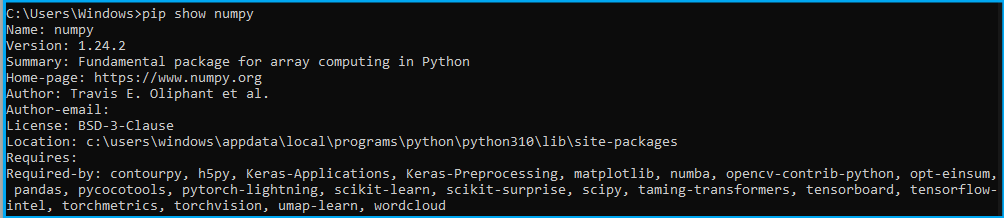
If you are unsure which version of NumPy you are currently using, you can check it by entering the following command in your terminal:
pip show numpy
This command will display information about your NumPy installation, including the version number.
If the version number is lower than 1.20.0, you should consider updating NumPy as described in the previous section.
- Importing TypedDict from Typing Module
If updating NumPy does not resolve the error, you can try importing TypedDict from the typing module.
TypedDict is a data type introduced in Python 3.8 that allows you to define a dictionary with specific key-value types.
To import TypedDict, add the following line to your code:
from typing import TypedDict
Now, replace all instances of ‘numpy.TypedDict’ with ‘TypedDict’ in your code. This should resolve the AttributeError.


Example Fixed module ‘numpy’ has no attribute ‘typeddict’
Here’s an example code that fixes the AttributeError: Module ‘NumPy’ Has No Attribute ‘TypedDict’, along with output and a print statement:
import numpy as np
from typing import TypedDict

# Define a custom TypedDict
class MyDict(TypedDict):
    key1: int
    key2: str

# Create a NumPy array
arr = np.array([1, 2, 3])

# Create a dictionary instance using the MyDict type
d = MyDict({'key1': 123, 'key2': 'value'})

# Print the array and dictionary
print("NumPy array:", arr)
print("TypedDict:", d)
Output:
NumPy array: [1 2 3]
TypedDict: {'key1': 123, 'key2': 'value'}
Conclusion
The AttributeError “Module ‘NumPy’ has no attribute ‘TypedDict’” can be caused by an outdated version of NumPy or by trying to access an attribute that does not exist in the NumPy module.
In this article, we have discussed two solutions to fix this error. The first solution is to update NumPy using pip, and the second solution is to import TypedDict from the typing module.
We hope that this article has helped you resolve this error and that you can now continue working on your Python projects without any issues.
If you are finding solutions to some errors you might encounter we also have Attributeerror: ‘dict’ object has no attribute ‘read’.
NumPy AttributeError patterns
NumPy AttributeErrors usually come from mixing Python lists with ndarrays, using removed aliases (np.int, np.float were dropped in 1.20+), or confusing scalar vs array methods.
Common triggers
- Deprecated type aliases.
np.int,np.float,np.boolwere removed in NumPy 1.20. Use built-inint,float,boolinstead. - Python list vs ndarray. A Python list has no
.shape,.reshape, or.dtype. Wrap withnp.array()first. - Scalar vs array methods. Some numpy methods return a scalar (int, float) that lacks array methods like
.reshape. - Attribute-vs-function confusion.
arr.maxis a method;arr.max()ornp.max(arr)is a value.
Diagnostic pattern
# BAD — np.int removed
sizes = np.array([1, 2, 3], dtype=np.int)  # AttributeError: module 'numpy' has no attribute 'int'

# GOOD — use built-in int or np.int64
sizes = np.array([1, 2, 3], dtype=int)      # ok
sizes = np.array([1, 2, 3], dtype=np.int64) # explicit width

# BAD — Python list has no .shape
raw = [[1, 2], [3, 4]]
raw.shape  # AttributeError: 'list' object has no attribute 'shape'

# GOOD — convert first
arr = np.array(raw)
print(arr.shape)  # (2, 2)
Best practices
- Check numpy version. Many API changes between 1.x and 2.x.
- Always convert with np.array() when moving from Python data structures.
- Use dtype explicitly.
np.int64,np.float32— no ambiguity. - Use type hints with numpy.typing. NDArray[np.int64] communicates shape expectations.
Official documentation
Frequently Asked Questions
What is Python AttributeError and what causes it?
AttributeError is raised when you access an attribute or method that doesn’t exist on the object. Most common cause: calling a method on None (NoneType has no attribute X). Other causes: typo in method name, wrong object type (str when you expected list), or using a feature removed in a newer library version. The error names exactly which type and which missing attribute.
How do I fix ‘NoneType object has no attribute’?
The variable you’re accessing is None, but you expected an object. Trace back to where it was assigned: a function returning None instead of an object (forgot to return), a database query returning no rows (Model.objects.first() returns None when empty), or an API call that failed silently. Safe pattern: if obj is not None: obj.method() OR use the walrus operator: if (obj := get_obj()): obj.method().
How do I check if an attribute exists before accessing it?
Use hasattr(obj, ‘attr_name’) for runtime check, or getattr(obj, ‘attr_name’, default) to get-with-default. For frequent attribute checks, consider type hints + mypy/pyright which catch most AttributeErrors at static-analysis time before runtime.
How do I prevent AttributeError from None values?
Three patterns: (1) Always validate function returns (if result is None: raise). (2) Use type hints with Optional[X] to make None-ability explicit. (3) Use the walrus operator + early return: if (val := get_val()) is None: return default; use val. Defensive coding around None-able returns prevents 90% of AttributeError in production.
Where can I find more AttributeError fixes?
Browse the AttributeError reference hub for 170+ specific fixes (NoneType, pandas, NumPy, sklearn, Selenium). For related errors see TypeError. For Python debugging fundamentals see Python Tutorial hub.

Glay Eliver
Programmer & Technical Writer at PIES IT Solution
Glay Eliver is a programmer and writer at PIES IT Solution, author of over 600 tutorials at itsourcecode.com. Specializes in JavaScript tutorials, Microsoft Office how-tos (Excel, Word, PowerPoint), and Python error debugging covering ImportError, TypeError, AttributeError, ModuleNotFoundError, and JavaScript ReferenceError. Authored several of the site’s highest-traffic Excel and MS Office reference articles.
Expertise: JavaScript · MS Excel · MS Word · MS PowerPoint · Python · Python ImportError · Python TypeError · Python AttributeError · ModuleNotFoundError · JavaScript ReferenceError · Pygame
· View all posts by Glay Eliver →