
How to Calculate Age using VB.Net
This tutorial is all about How to Calculate Age using VB.Net. With this tutorial you can Calculate Age using VB.Net. easily. So let’s get started:
- First is open the Visual Basic, Select File on the menu, then click New and create a new project.
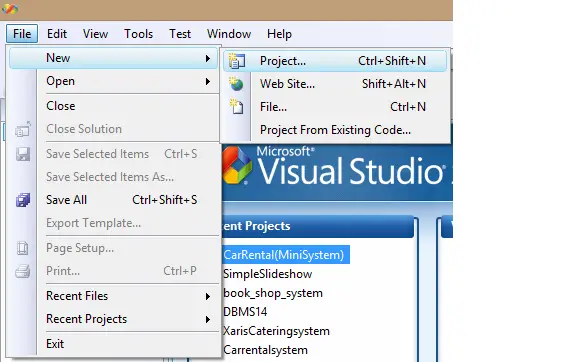
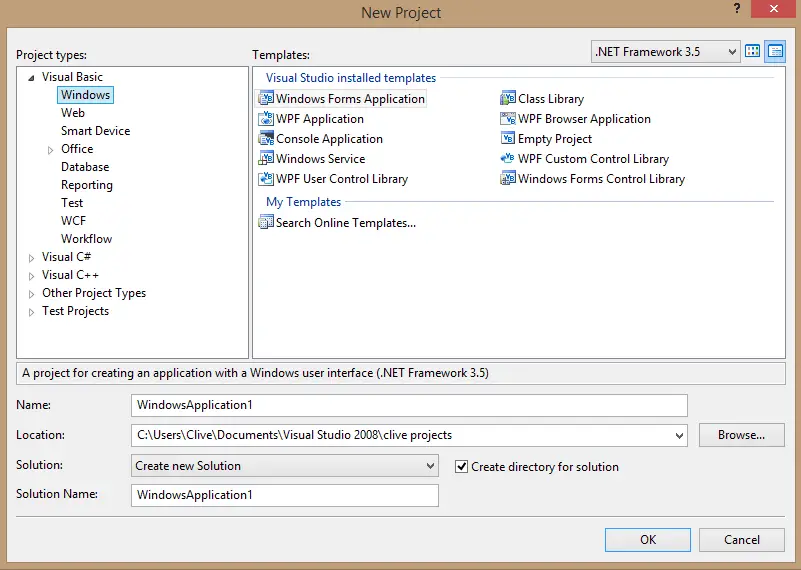
- Then a New Project Dialog will appear. You can rename your project, depending on what you like to name it. After that click OK
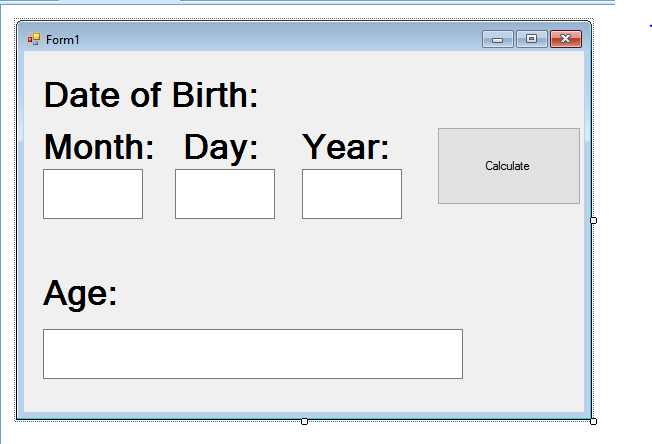
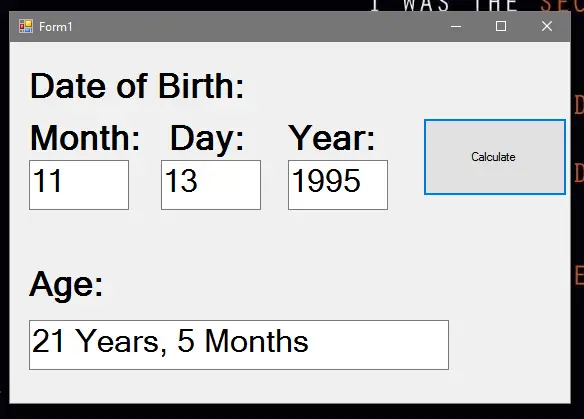
- Design your form like this just like what I’ve shown you below.
Add a Label, 4 Textbox, and a Button.
- After Designing your form, Add this code to the button.
[vbnet]
Private Sub Button1_Click(ByVal sender As System.Object, ByVal e As System.EventArgs) Handles Button1.Click
Dim a As String
Dim b As String
Dim c As String
a = TextBox3.Text
b = TextBox1.Text
c = TextBox2.Text
Dim DOB As New DateTime(a, b, c)
Dim Years As Integer = DateDiff(DateInterval.Year, DOB, Now) - 1
Dim Months As Integer = DateDiff(DateInterval.Month, DOB, Now) Mod 12
Dim days As Integer = DateDiff(DateInterval.Day, DOB, Now) Mod 30 - 10
TextBox4.Text = Years & " Years, " & Months & " Months "
End Sub
[/vbnet]- Finally, Click F5 to run Program.
Output:
If you have any comments or suggestion about on How to Calculate Age using VB.Net, Please Feel Free to contact our webpage.
Download How to Calculate Age using VB.Net Code Here
Other articles you might read also:
Project timeline estimate for BSIT capstone
Typical BSIT capstone teams complete a VB.NET project of this scope in one full academic semester. Suggested timeline:
- Weeks 1-2. Requirements gathering, interview with the target user or institution, and initial documentation of Chapter 1.
- Weeks 3-4. Design phase: use case diagram, DFD, ER diagram, and mockup screens on paper or Figma.
- Weeks 5-8. Core development: database schema in MySQL, main forms in Visual Studio, CRUD operations.
- Weeks 9-11. Reports, printing, and user roles. Test with actual sample data from the target institution.
- Weeks 12-13. Documentation: finalize Chapter 3 methodology, Chapter 4 screenshots, and Chapter 5 conclusion.
- Week 14. Mock defense with adviser, corrections, and final panel presentation.
Panel questions this project typically gets
Prepare answers to these questions before your capstone defense — panel members ask them almost every time:
- What existing systems are similar and how is yours different? Prepare a comparison table showing 3-5 alternatives (usually commercial products or older thesis work) and the specific gaps your project addresses.
- How do you validate data entry to prevent bad input? Walk through the validation logic on 2-3 key forms, showing regex checks, range validation, and required-field enforcement.
- How does the system handle concurrent access? Explain your database transaction strategy — SQL locking, timestamps, or optimistic concurrency.
- What is your backup and disaster recovery plan? Have a documented backup schedule (daily, weekly) and a restore-from-backup demo ready.
- How would you deploy this in production? Explain the Windows installer, database setup script, and how updates would be delivered.
Deployment options after the defense
Once you graduate, this system can be extended into a real product with these deployment paths:
- Local Windows install. Package with Visual Studio’s built-in ClickOnce installer for small businesses that only need one computer.
- Multi-terminal LAN. Host MySQL on one server PC and let 3-5 client PCs connect over the office network.
- Cloud migration. Move the database to Azure SQL or AWS RDS and keep the Windows Forms front-end for existing users.
- Web rewrite. Rebuild the front-end in ASP.NET Core or React while keeping the same database and business logic.
Common defense pitfalls to avoid
- Empty database. Always pre-populate 20-50 realistic sample records so demos are meaningful — an empty grid looks unfinished.
- Missing error handling. Panel members love breaking your system. Wrap every database call in Try/Catch and show user-friendly error messages.
- No printable output. Every capstone panel expects at least one printable report. Add a Print Preview form.
- Untested login. Prepare a demo Admin user, a demo Encoder user, and confirm both work before showing the panel.
- No backup demo. Have a scripted database-backup and restore demo ready in case the panel asks.
Where to get help while building
- itsourcecode.com free downloads. Browse other VB.NET projects for similar patterns and code examples.
- Microsoft Learn VB.NET docs. The official reference for language syntax and .NET class libraries.
- Stack Overflow VB.NET tag. Fastest place to get unstuck on a specific error message.
- YouTube capstone walkthroughs. Search for demos of similar systems to see how other students structure their defense.
- Your adviser. Regular check-ins keep the project on track and surface issues early rather than at defense day.
Alternative age-calculation approaches in VB.NET
The DateTime subtraction method is the standard approach, but a few alternatives are useful in specific cases:
- DateDiff function. Returns the difference between two dates in a specific interval (years, months, days). Handy for legacy VB6 developers but less precise than DateTime arithmetic.
- Custom AddYears() logic. Handles edge cases like leap-year birthdays (February 29) where the person turns one year older on Feb 28 or March 1 depending on the year.
- NodaTime library. Third-party NuGet package that handles timezones, cultures, and calendars far better than the built-in DateTime for international apps.
- Business-day arithmetic. For loan or contract age, exclude weekends and holidays using a custom Function that checks each day between the two dates.
Official documentation
Frequently Asked Questions
How does this VB.NET project work?
Built with VB.NET WinForms (.NET Framework 4.5+) and SQL Server backend. Standard structure: Form designer to code-behind event handlers to ADO.NET data access layer to SQL Server. Login form for auth. Ready to extend for BSIT capstone scope.
What Visual Studio and SQL Server versions does this VB.NET project require?
Most projects use VB.NET WinForms on .NET Framework 4.5+ with SQL Server 2012 Express or higher. To run: install Visual Studio 2019 / 2022 (Community is free) with the ‘Desktop development with .NET’ workload, install SQL Server Express + SSMS, open the .sln file, build, run.
How do I set up the database for this VB.NET project?
Open SQL Server Management Studio (SSMS) and connect to your SQL Server (e.g. localhost\SQLEXPRESS). Right-click Databases, choose Restore Database OR New Database then import the included .sql script. Update the connection string in App.config (or in code-behind Module) with your server name + credentials. Rebuild and run.
Can I use this VB.NET project for a BSIT capstone or thesis?
Yes, VB.NET is one of the most accepted languages by Philippine BSIT panels. Extend it: add role-based access (admin/staff/customer login redirect), Crystal Reports or RDLC reports, dashboards with Chart control, audit log, multi-branch support. Pair with Chapter 1-5 documentation matching your panel’s rubric.
Why am I getting ‘connection error’ or ‘cannot find SQL Server’?
Three common VB.NET issues: (1) Connection error: SQL Server isn’t running. Open SQL Server Configuration Manager and verify SQL Server (SQLEXPRESS) service is started. (2) Wrong server name in connection string. Try .\SQLEXPRESS, (local)\SQLEXPRESS, or your machine name. (3) Login failed: SQL Server is set to ‘Windows-only’ authentication. Switch to Mixed Mode in SSMS Server Properties, Security.
Where can I find more VB.NET projects with source code?
Browse the VB.NET Projects hub for the full library. For C# WinForms alternatives see C# Projects. For ASP.NET web alternatives see ASP.NET Projects. For BSIT capstone idea lists see 150 Best Capstone Project Ideas.
It is not correct